









Launching a mobile service used to require years of telecom integration work, specialist infrastructure and significant capital investment. Today, digital MVNO platforms are changing that. But what is a digital MVNO platform? Put simply, a digital MVNO platform is an end-to-end software and enablement layer that gives businesses the tools to launch, manage and scale a mobile service without owning network infrastructure.
Businesses can launch an MVNO or branded mobile propositions, eSIM services and embedded connectivity products using a single cloud-based platform rather than building complex telecom infrastructure from scratch or relying on fragmented MVNO software.
For MVNO founders, commercial teams, and digital brands, launching a mobile service no longer requires a multi-year infrastructure project. With the right platform, a business can focus on its proposition, pricing, customer experience and growth while the platform provider handles the telecom technology layer.
In this guide, we’ll explain what a digital MVNO platform includes, how it differs from traditional MVNO software, how it fits into the MVNO and MVNE ecosystem, and what to look for when choosing a platform partner.
Summary
A digital MVNO platform helps businesses launch, manage and scale mobile services without owning network infrastructure. It combines key telecom capabilities, including billing, CRM, eSIM provisioning, subscriber management, analytics, customer self-care and network connectivity, into one platform. This makes it easier for MVNOs, digital brands, fintechs and travel companies to launch faster, reduce complexity and deliver a digital-first customer experience.
What Is a Digital MVNO Platform?
A digital MVNO platform is a cloud-based telecom platform that enables a business to operate as a Mobile Virtual Network Operator without building its own mobile network or stitching together multiple legacy telecom systems.
In practical terms, it brings together the core systems needed to run a mobile service:
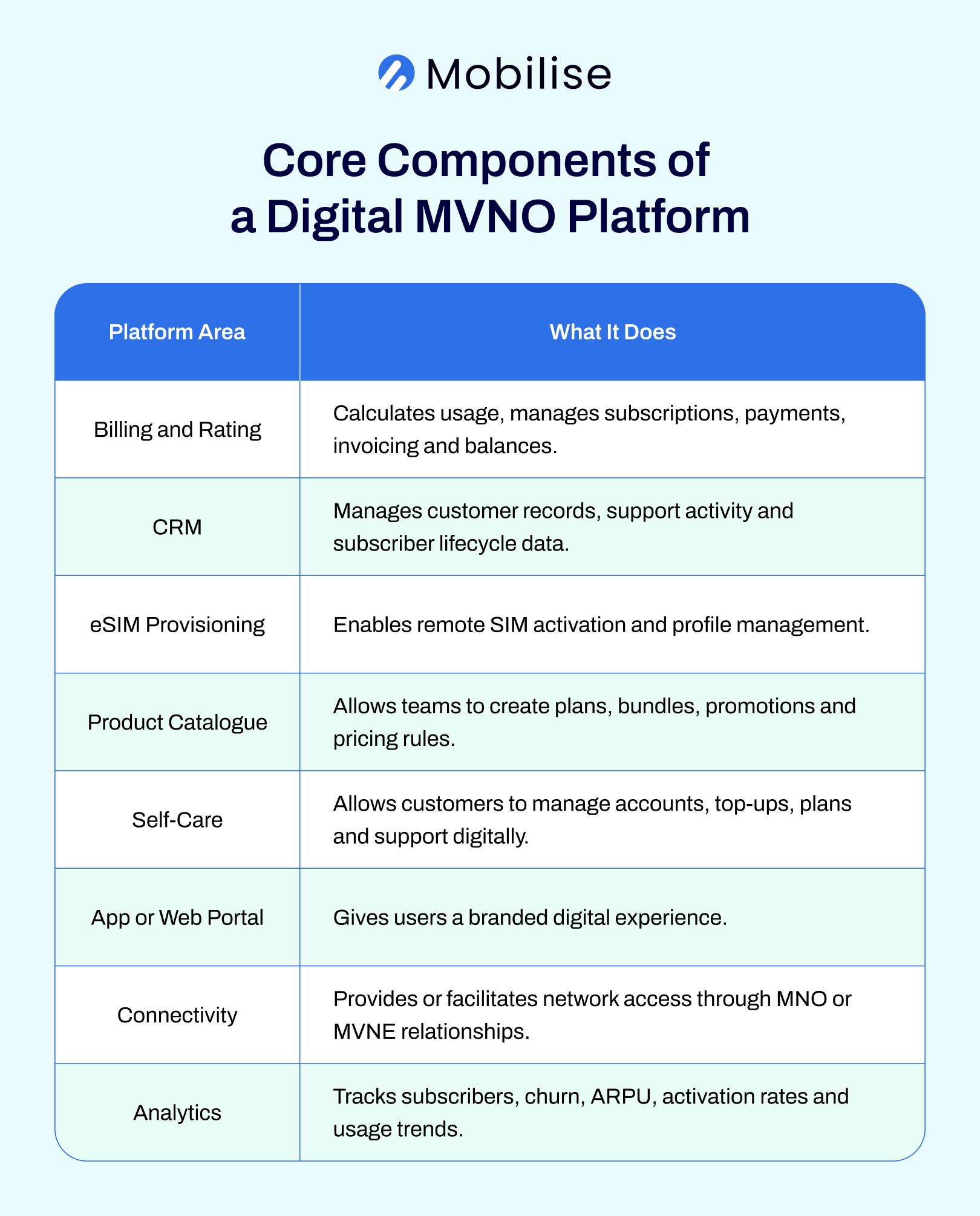
Traditional MVNO infrastructure was often built around physical SIM cards, retail distribution, and legacy billing processes. A digital MVNO platform, however, is designed for app-first onboarding, eSIM activation, faster and more flexible product launches, and customer self-service.
That makes it particularly relevant for travel eSIM providers, fintechs, digital banks, niche MVNOs, esim mvno brands, community brands, loyalty programmes, retail brands, and established telecom operators looking to modernise the customer experience.
MVNO vs MVNE vs Digital MVNO Platform
These terms are closely connected, but they do not mean the same thing.
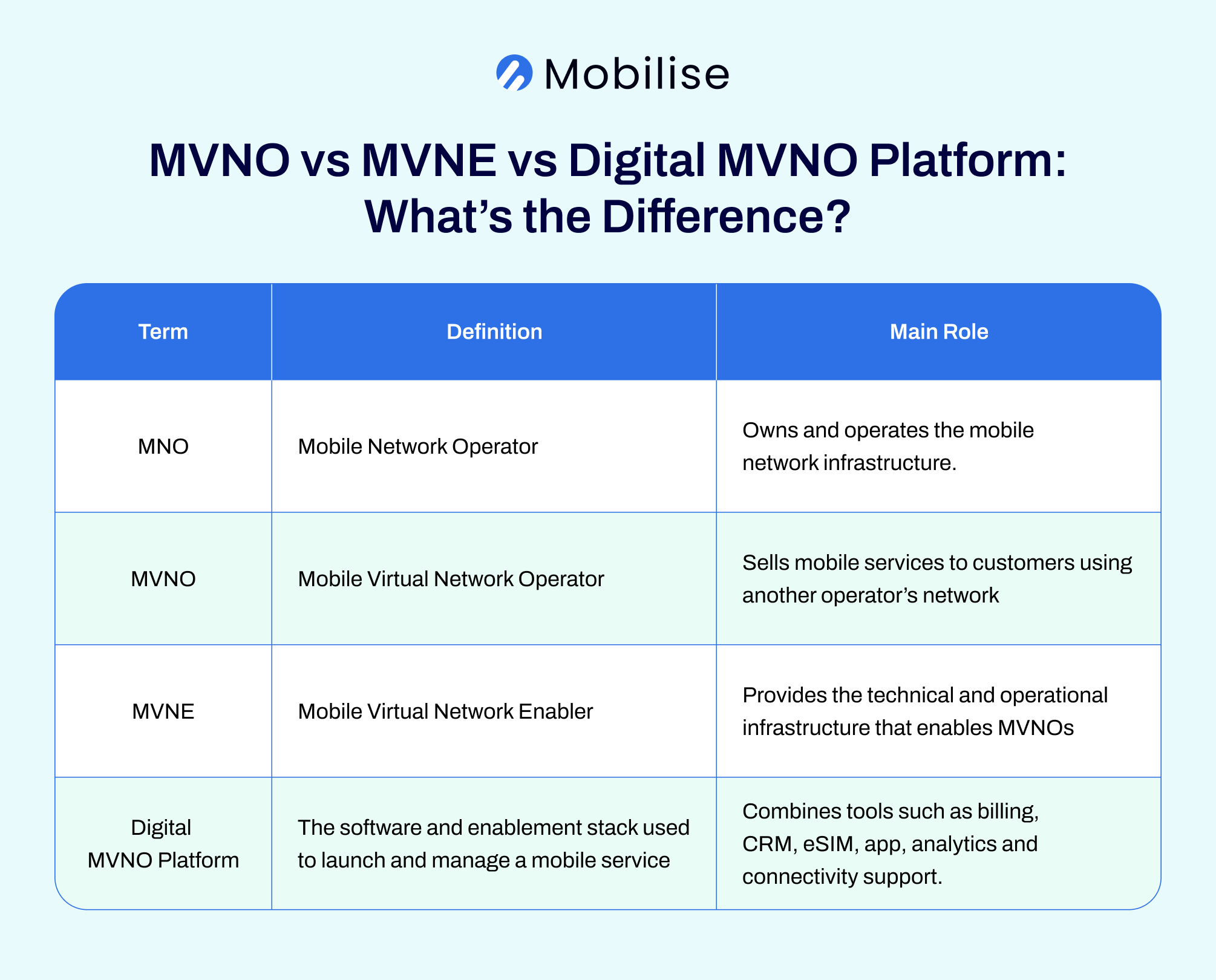
An MVNO owns the customer relationship. It defines the proposition, sets pricing, manages the brand and sells mobile services to end users.
An MVNE provides the infrastructure layer for the MVNO. This can include network interconnects, billing, provisioning, operational support systems and compliance support. An MVNE platform is the environment that delivers these enablement capabilities at scale.
A digital MVNO platform brings these functions into a more unified, software-led environment. In many cases, the platform provider also acts as the MVNE, giving the MVNO both the operational tools and the enablement infrastructure from a single partner.
This is an important because managing separate vendors for billing, eSIM, CRM, payments, app development, analytics and network access can increase costs, add complexity and slow down delivery. A platform-led model helps reduce that fragmentation.
Why Digital MVNO Platforms Are Growing Rapidly
The demand for digital MVNO platforms is growing because several major industry trends are reshaping how mobile services are launched, distributed and consumed. Juniper Research forecasts that global MVNO subscribers will reach 438 million by 2030, driven in part by the rise of MVNO-in-a-Box platforms.
Historically, launching an MVNO required significant investment in telecom infrastructure, specialist expertise and multiple technology vendors. This created high barriers to entry and limited the market primarily to established telecom providers. And today, those barriers are falling.
The rise of eSIM technology has removed many of the logistical challenges associated with physical SIM cards, enabling fully digital customer acquisition and activation journeys. Customers can now purchase, download and activate a mobile service in minutes without visiting a store or waiting for a SIM card to arrive.
At the same time, connectivity is increasingly being embedded into products and services that are not traditionally telecom businesses. Travel brands are launching eSIM services for international travellers. Fintech companies are exploring mobile propositions as part of broader digital ecosystems. Retailers, loyalty programmes and digital communities are using connectivity to deepen customer engagement and create new revenue streams.
Cloud-native telecom platforms have also significantly reduced the complexity of launching and operating mobile services. Capabilities that once required multiple vendors and lengthy integration projects can now be delivered through a single platform. This shift is changing the role of connectivity.
Rather than being sold as a standalone telecom product, connectivity is increasingly becoming a feature within a broader customer experience. Businesses are no longer asking how to become a telecom operator. They are asking how connectivity can support customer acquisition, retention, loyalty and engagement.
As a result, digital MVNO platforms are becoming an important part of the telecom value chain, enabling organisations to launch mobile propositions faster, with lower risk and significantly reduced technical complexity.
What Should a Digital MVNO Platform Include?
A modern MVNO platform should cover the full operational stack, from customer onboarding to billing, provisioning and reporting.
1. Billing and Rating
Billing is one of the most important components of any MVNO operation. The platform should support real-time charging, usage rating, recurring subscriptions, pay-as-you-go models, bundles, top-ups, invoicing, refunds and payments.
For digital MVNOs, billing should also support flexible products, including travel eSIM plans, local data bundles, regional packages and promotional offers.
The key question is whether commercial teams can launch and adjust pricing without constant engineering support.
2. CRM and Subscriber Management
A digital MVNO needs a clear view of every subscriber. That includes onboarding status, active plans, usage, payments, support history, lifecycle stage, churn risk and reactivation opportunities.
A built-in CRM keeps customer data connected to billing, provisioning and support. This reduces operational silos and gives teams the visibility they need to manage subscribers effectively.
3. eSIM Provisioning
For many digital-first MVNOs, eSIM is no longer an add-on. It’s the foundation of the customer experience.
eSIM enables remote SIM provisioning, allowing users to download and activate a mobile plan without waiting for a physical SIM card. The GSMA describes eSIM as a global specification that enables remote SIM provisioning for mobile devices, and its consumer eSIM specifications define the technical framework for this process.
A strong platform should support seamless eSIM activation, profile lifecycle management, QR code or in-app installation flows, and integration with the customer-facing app or portal.
4. Product Catalogue Management
The product catalogue is where teams create, manage and launch mobile plans.
A flexible catalogue should allow operators to configure:
- data bundles
- voice and SMS plans
- travel eSIM packages
- recurring subscriptions
- promotions
- regional or country-specific plans
- add-ons
- usage rules
- pricing tiers
This is especially important for digital MVNOs that need to test propositions quickly. If every pricing change requires technical development, the platform will slow the business down.
5. Customer Self-Care
Digital customers expect to manage their mobile service themselves. They should be able to activate a plan, check usage, top up, change plan, update payment details and contact support through an app or web portal.
Self-care reduces support costs, but it also improves the customer experience. For digital MVNOs, the app or portal is often the main relationship between the brand and the subscriber.
6. White Label App or Web Experience
For many digital MVNOs, the app is the product. It’s where customers onboard, activate their eSIM, manage plans, make payments and get support.
A digital MVNO platform should either provide a white label app that can be branded and customised, or offer the APIs and documentation needed for teams building their own front end.
If brand ownership matters, the platform should support a fully white labelled experience with no visible vendor branding.
7. Network Connectivity
An MVNO needs access to mobile network infrastructure. A digital MVNO platform should either provide this through its own MVNE capability or support integration with the operator’s chosen carrier agreements.
Carrier flexibility is important. Multi-carrier support can help operators improve coverage, reduce dependency on one network partner and adapt as their subscriber geography changes.
8. Analytics and Reporting
Operators need real-time visibility into performance. At a minimum, the platform should report on subscriber growth, churn, ARPU, data consumption, activation rates, failed payments, support volumes and plan performance.
Analytics should not be an afterthought. It should help commercial, marketing, product and support teams make better decisions.
Why Digital-First MVNOs Need a Different Platform
A travel brand launching an eSIM product, a fintech adding mobile plans to its app, or a niche MVNO targeting a specific community will not operate like a traditional telecoms provider.
These businesses need speed, flexibility and a strong digital customer journey from day one.
Traditional MVNO infrastructure was designed for a slower operating model. It often assumes physical SIM logistics, retail distribution, long network negotiation cycles and complex legacy billing systems.
Digital-first MVNOs need something different.
They need to launch an MVNO quickly. The platform should shorten the path from idea to live service by bringing core systems together in one place.
They need to adapt quickly. Commercial teams should be able to create plans, test offers and update pricing without waiting weeks for development work.
They need a better customer journey. Onboarding, eSIM activation, payment, account management and support should happen digitally, with minimal friction.
They need lower operational complexity. A platform-led model reduces the need to manage multiple disconnected vendors.
They need scalability. The platform should support the business at launch and as the subscriber base grows.
How to Choose the Right Digital MVNO Platform
Choosing an MVNO platform is one of the most important decisions a new mobile business will make. The platform affects launch timelines, customer experience, operating costs, commercial flexibility and long-term scalability.
Here are the main criteria to evaluate:
Speed to Launch
Ask how quickly the provider can get a comparable operator live. Do not rely only on best-case timelines. Ask for examples based on similar propositions, regions and levels of customisation.
A platform that is genuinely launch-ready should already include the core modules needed to operate.
Platform Completeness
Check whether the provider covers the full stack or only part of it. Some platforms describe themselves as end-to-end but still require separate vendors for billing, app development, eSIM, payments, CRM or analytics.
The more gaps there are, the more integration work you will need to manage.
eSIM Capability
If your proposition is digital-first, eSIM support is essential. Look at the quality of the activation journey, the provisioning architecture, the user experience and the support available if activation fails.
eSIM isn’t just a technical feature; it’s part of the customer journey.
Carrier and Coverage Options
Ask which markets, regions and carriers the platform can support. If you plan to scale internationally, make sure the platform can support your target geographies and future expansion plans.
Commercial Flexibility
The platform should allow you to quickly create and test products. Look for flexible pricing models, product catalogue controls, promotions, bundles and add-ons.
This is especially important if you are launching into a competitive or fast-moving segment.
Integration and API Quality
Even with an end-to-end platform, you may still need integrations with payment providers, analytics tools, marketing automation, customer support software or existing business systems.
Review API documentation, integration examples and support processes before committing.
White Label Control
If your brand is central to your proposition, make sure the platform gives you full control over the customer-facing experience. This includes the app, portal, transactional emails, notifications, support flows and payment journey.
Ongoing Support
Launch is only the beginning. Look for a partner that provides technical support, product guidance, operational expertise and a clear roadmap.
The right partner should help you grow, not simply hand over software.
How Mobilise Supports Digital MVNO Launches
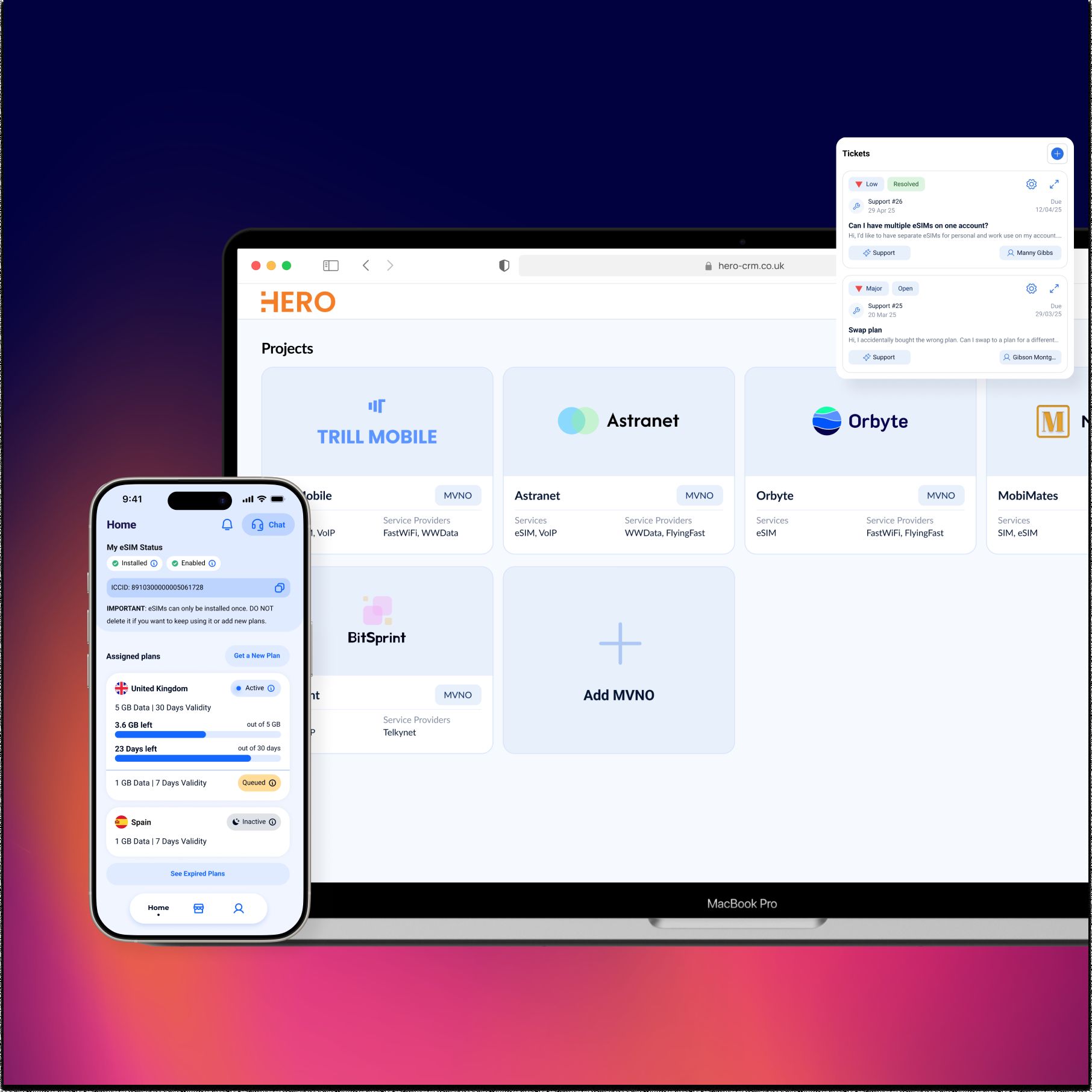
Mobilise helps businesses launch and scale digital mobile services through HERO®, its telecom enablement platform.
Unlike traditional MVNO stacks that require multiple vendors and integrations, HERO® provides a unified platform covering subscriber management, billing, CRM, eSIM enablement, product management, analytics and customer-facing applications from a single environment.
Mobilise also supports the MVNE layer, helping clients access the infrastructure and operational support needed to bring mobile propositions to market. This makes HERO® suitable for businesses launching a new MVNO, adding connectivity to an existing digital product, or modernising an existing mobile proposition.
For digital brands, travel companies, fintechs, telecom operators and new MVNO founders, the value is simple: faster launch, reduced technical complexity and a better experience for end users.
Conclusion
A digital MVNO platform is the foundation for a modern mobile service. It brings together the systems and infrastructure needed to launch, manage and scale an MVNO, from billing and eSIM provisioning to CRM, analytics and customer self-care.
For digital-first operators, speed and customer experience are critical. The right platform helps businesses launch faster, reduce technical complexity and keep control of the subscriber relationship.
Ready to launch a digital MVNO? Book a demo with Mobilise to see how our platform can support your launch.
Frequently Asked Questions
What Is a Digital MVNO Platform?
A digital MVNO platform is a cloud-native mobile virtual network operator platform that centralizes the tools necessary for businesses to launch and manage mobile services without needing to build their own telecom infrastructure.
How Does a Digital MVNO Platform Differ From Traditional MVNO Software?
Traditional MVNO software often involves physical SIM card logistics and multiple legacy systems. In contrast, a digital MVNO platform is designed for app-first onboarding, eSIM activation, and offers an integrated software environment that simplifies the management of mobile services.
What Are the Key Components of a Digital MVNO Platform?
Key components include billing and rating systems, CRM and subscriber management, eSIM provisioning, product catalogue management, customer self-care, a white-label app or web experience, network connectivity, and analytics and reporting.
Why Are Digital MVNO Platforms Gaining Popularity?
The demand is rising due to trends such as the decline of barriers to entry in launching mobile services, the rise of eSIM technology, and the need for businesses to embed connectivity into their products for improved customer engagement.
What Should Businesses Look for When Choosing a Digital MVNO Platform?
Businesses should evaluate the speed to launch, platform completeness, eSIM capability, carrier and coverage options, commercial flexibility, integration and API quality, white label control, and ongoing support.
Can a Digital MVNO Platform Support Multiple Markets and Carriers?
Yes, many digital MVNO platforms offer multi-carrier support and can adapt to target various markets and regions, which is crucial for businesses planning to scale internationally.
How Does eSIM Technology Benefit Digital MVNOs?
eSIM technology allows for remote SIM provisioning, enabling users to activate mobile plans instantly without the need for a physical SIM card, which simplifies the customer acquisition process.
What Is the Role of a White Label App in a Digital MVNO Platform?
A white-label app allows businesses to have a customized, branded app where customers can manage their mobile services. This enhances brand visibility and customer experience.
How Can Mobilise Support Businesses in Launching a Digital Mvno?
Mobilise offers the HERO® telecom enablement platform, which provides a unified solution covering subscriber management, billing, CRM, eSIM enablement, product management, and analytics, helping businesses launch their digital MVNO services faster and with reduced complexity.