









One month on, MWC 2026 telecom trends marked a turning point for the industry. This year, one thing was clear. The conversation has shifted from experimentation to execution, from exploring new models to proving what actually works commercially.
Travel eSIM Moves Into the Mainstream
Travel eSIM emerged as a consistent theme at MWC 2026. What was once seen as a roaming alternative has now matured into a well-established product category.
Operators, fintechs, travel platforms, and digital brands are actively exploring ways to build or expand their offerings. This transformation is driven by both market demand and consumer behaviour.
Traditional roaming methods are becoming increasingly difficult to justify financially. Users who once paid daily roaming fees or faced hefty bills can now access affordable data bundles that offer much better value. For example, roaming in Japan on UK networks can cost between £5-£7 per day for daily passes or up to approximately £45 per GB if paying standard roaming rates. With eSIMs, around £11 can buy 10GB of data for use in Japan over 30 days – a significant shift from traditional roaming costs.
Adoption of eSIMs follows this trend, with about 12% of international travellers already using eSIMs abroad, as both telcos and non-telco providers vie for market share. However, the broader change is structural. Travel eSIM is no longer just a telecom product; it’s becoming integrated into wider digital ecosystems: travel platforms offering eSIM as part of bookings or loyalty programmes, fintechs bundling connectivity into premium accounts, and digital brands using eSIM to boost customer engagement.
This creates new revenue opportunities but also intensifies competition. The key question has shifted from “Can we offer travel eSIM?” to “How do we build a profitable and distinctive proposition?”
This involves focusing on distribution and customer ownership, product experience and ease of use, and commercial models that go beyond simple price competition.
Travel eSIM is no longer a roaming alternative; it’s becoming a primary distribution channel for global connectivity.
The MVNO Model Is Evolving, Not Disappearing
Alongside travel eSIM, another significant theme was the resurgence of the MVNO model. However, this isn’t a return to traditional MVNO strategies.
What is emerging is a new wave of digital-first MVNOs, centred around:
- Vertical-specific propositions
- Embedded connectivity within existing products
- A stronger emphasis on brand and customer experience
Lower barriers to entry and more adaptable infrastructure are facilitating this change. But just as importantly, expectations have shifted. The market no longer asks how to launch quickly, and instead, it focuses on how to build something sustainable.
This is where MVNE platforms become crucial. Rather than rebuilding telecom infrastructure from scratch, companies are seeking scalable platforms that enable them to launch, iterate, and grow without unnecessary complexity.
Digital-First Telecom Is Now the Baseline
One of the clearest lessons from MWC 2026 is that digital-first telecom is no longer a competitive advantage; it’s the standard. Operators and digital players alike are concentrating on:
- Reducing time to market
- Simplifying technology stacks
- Delivering app-based, seamless customer experiences
- Integrating connectivity into broader digital services
This shift is increasing demand for modular, API-driven platforms capable of supporting multiple use cases, from travel eSIM to full MVNO launches. The expectation is not just speed but also flexibility and scalability from the outset.
AI in Telecom – AI Is Everywhere, but Still Maturing
AI was impossible to ignore at MWC 2026. Across infrastructure, operations, and enterprise solutions, it’s becoming embedded into every layer of telecom. This aligns with the broader industry shift towards what is being described as the “IQ Era”, where AI underpins networks, platforms, and services. At the same time, there’s still a gap between ambition and execution.
Clear areas of progress include:
- AI-driven network automation
- Edge AI for enterprise use cases
- Distributed AI infrastructure.
However, there is also a noticeable level of hype. The long-term impact of AI isn’t in question; the challenge now is transforming that potential into commercially viable, scalable solutions.
What This Means For Telecom Operators and Digital Brands
Across these MWC 2026 themes, a common pattern is emerging. Control is becoming increasingly vital.
Whether it concerns travel eSIMs, MVNO propositions, or AI-enabled services, the key questions operators and digital brands are asking are:
- How do we own the customer relationship?
- How do we control distribution?
- How do we avoid becoming just another layer in someone else’s ecosystem?
Simultaneously, speed remains crucial. The ability to launch rapidly, test propositions, and scale successful models is now a vital competitive advantage.
Where Mobilise Fits
These trends validate a direction we’ve been investing in for several years: eSIM-first connectivity, digital MVNO platforms, and fully app-based telecom experiences.
Across conversations with operators, partners, and new prospects, the same priorities kept coming up:
- eSIM-first connectivity
- Travel eSIM as a growth opportunity
- Scalable MVNO and MVNE platforms
- Digital-first telecom operations
These are the foundations of the HERO® Platform.
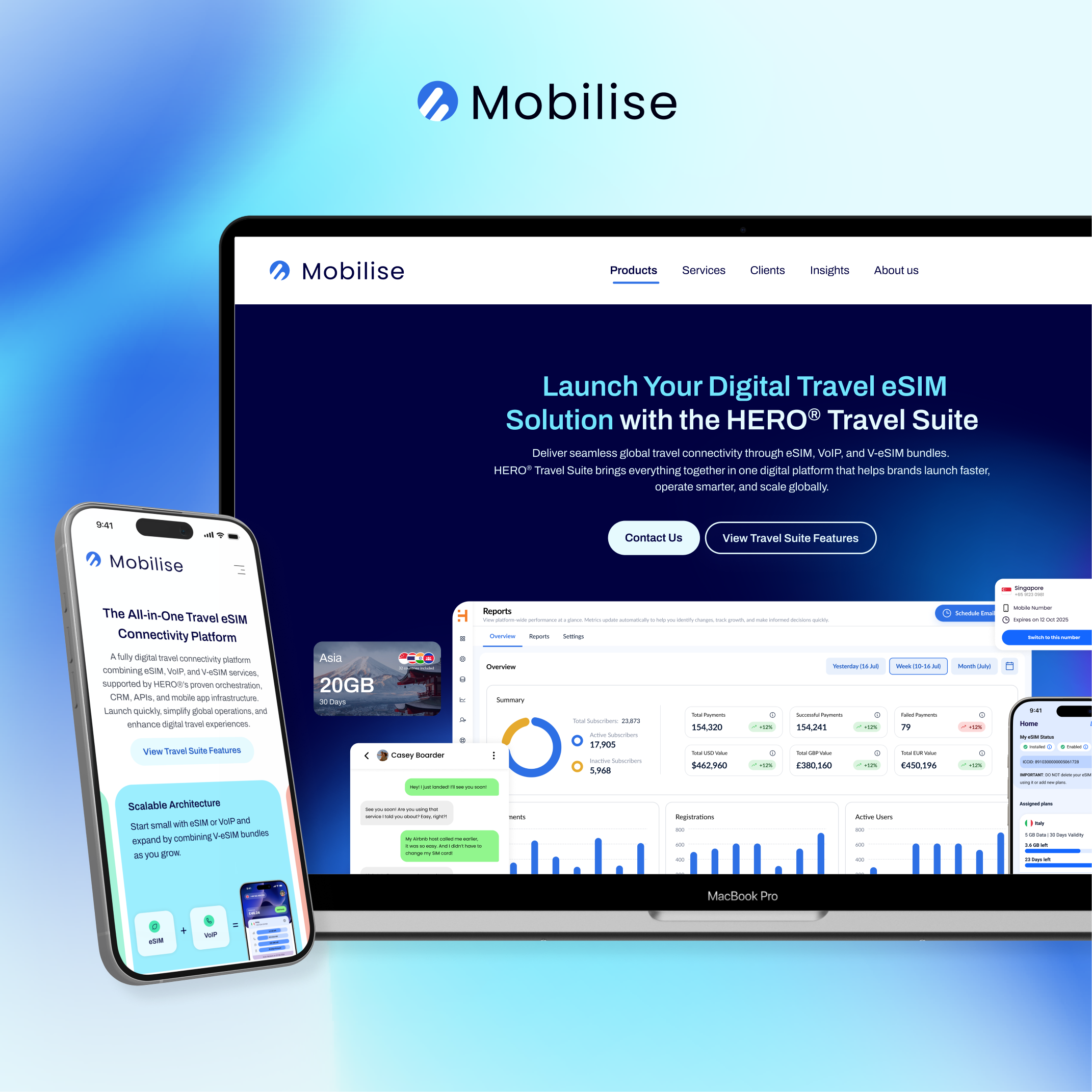
From Travel eSIM to MVNO and MVNE enablement, the focus has been on building infrastructure that supports real-world business models, not just technical capability.
The quality of conversations and leads at MWC this year reflected that alignment.
Final Thoughts
MWC 2026 didn’t present entirely new ideas.
What it demonstrated is that the industry is prepared to act on them. Travel eSIMs are expanding beyond early adoption. MVNO models are becoming more targeted and commercially focused. Digital platforms are now essential infrastructure. AI is shaping the next stage of telecom evolution.
The opportunity is significant. However, the winners will be those who can act swiftly, develop sustainable models, and retain control of their customers and their experience.
If you’re exploring how to launch or scale a travel eSIM or digital MVNO proposition, we’re happy to share what we’re seeing across the market .
To learn more about how Mobilise can support your journey, explore our HERO® platform or get in touch with our team.