








What Makes a Digital MVNO Different from a Traditional MVNO?
In Part 1 of this series, I looked at a question many businesses face before entering connectivity: should we build, buy or embed?
But for organisations that decide an MVNO is the right model, another question quickly follows: What actually makes an MVNO digital?
It is tempting to think the answer is simple. Launch an app. Add eSIM. Move customer service online. You now have a digital MVNO.
I don’t think that goes far enough.
A business can have a very modern mobile app while still running highly manual processes, disconnected back-end systems and operational models designed around traditional telecom. Equally, an established MVNO can modernise its technology and operating model without needing to reinvent its entire business.
The real difference is not the interface. A digital MVNO is digital across the customer lifecycle, operating model and underlying technology architecture.
What Is a Digital MVNO?
An MVNO, or Mobile Virtual Network Operator, provides mobile services to customers without owning the underlying radio access network. It typically relies on an MNO or MVNE for some elements of network infrastructure while retaining responsibility for areas such as its proposition, pricing, brand and customer relationship.
A digital MVNO uses the same fundamental model, but designs the business around digital-first customer journeys, automation, self-service, APIs and data.
That distinction is important. “Digital MVNO” is not really a different regulatory category of operator. It is better understood as an operating and product model.
The question is not: “Does the MVNO have an app?” It is: “How much of the business can operate digitally from customer acquisition through to customer exit?”
Why the Digital MVNO Model Matters Now
The shift towards digital MVNO models is happening alongside several broader changes in connectivity.
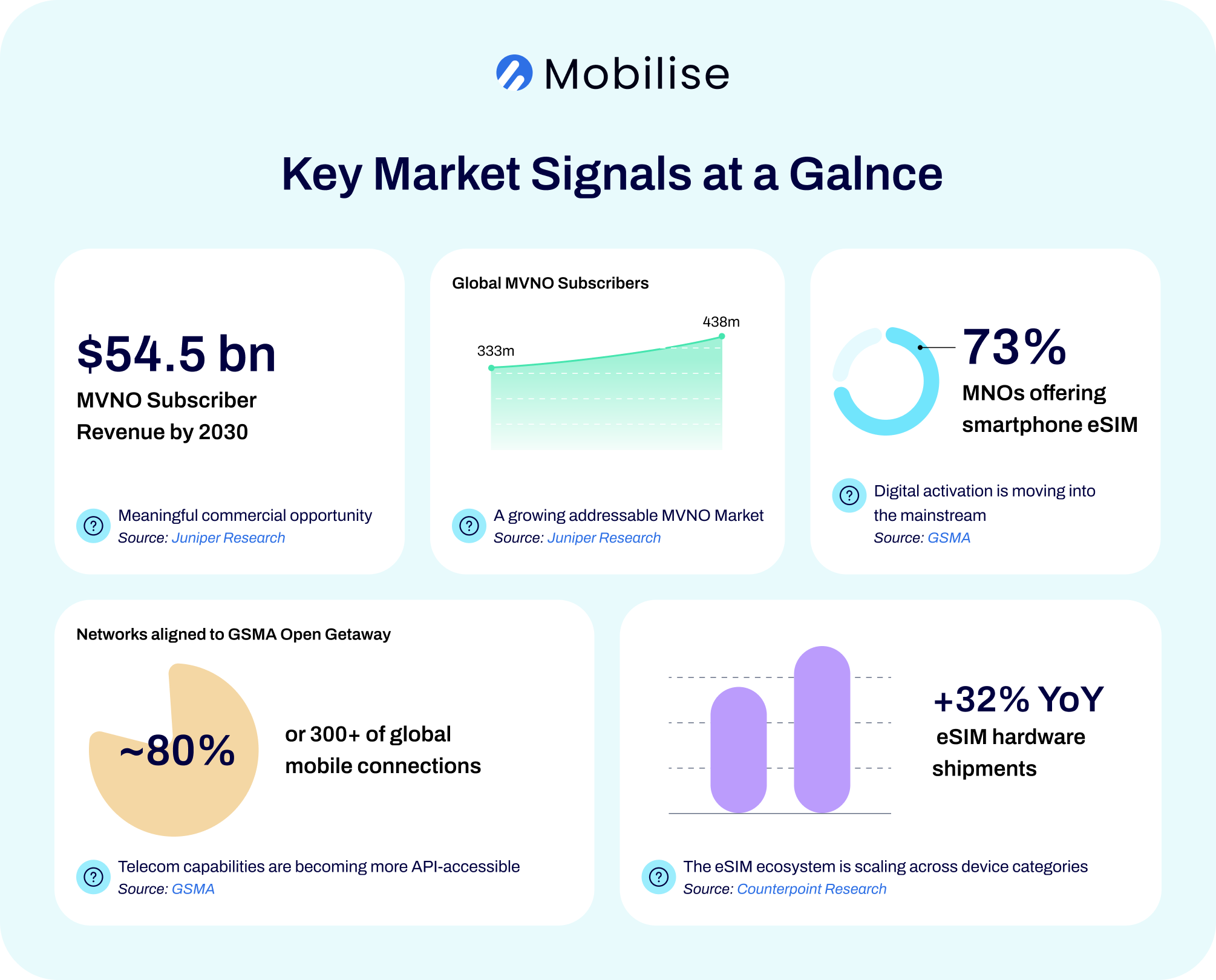
The MVNO market continues to expand. Juniper Research estimates that 333 million subscribers will use MVNO services globally in 2026, rising to 438 million by 2030, while total MVNO subscriber revenue is forecast to reach $54.5 billion by 2030. Juniper also identifies “MVNO in a Box” platforms as one of the factors enabling more non-telecom businesses to enter the connectivity market. [1]
At the same time, one of the biggest technical barriers to fully digital mobile journeys is disappearing. The GSMA reported in 2026 that 73% of mobile network operators already offer commercial eSIM services for smartphones. [2]
The wider eSIM ecosystem is scaling too. Counterpoint Research reported that eSIM hardware shipments increased 32% year-on-year in 2025 across consumer, automotive and IoT devices. [3]
Telecom infrastructure itself is becoming more programmable. By March 2026, 86 operator groups representing more than 300 networks and around 80% of global mobile connections were aligned around the GSMA Open Gateway common API framework. [4]
Taken together, these trends point in the same direction: launching a mobile proposition is becoming less dependent on owning every layer of telecom infrastructure and more dependent on how effectively a business can orchestrate networks, platforms, digital journeys and customer experiences.
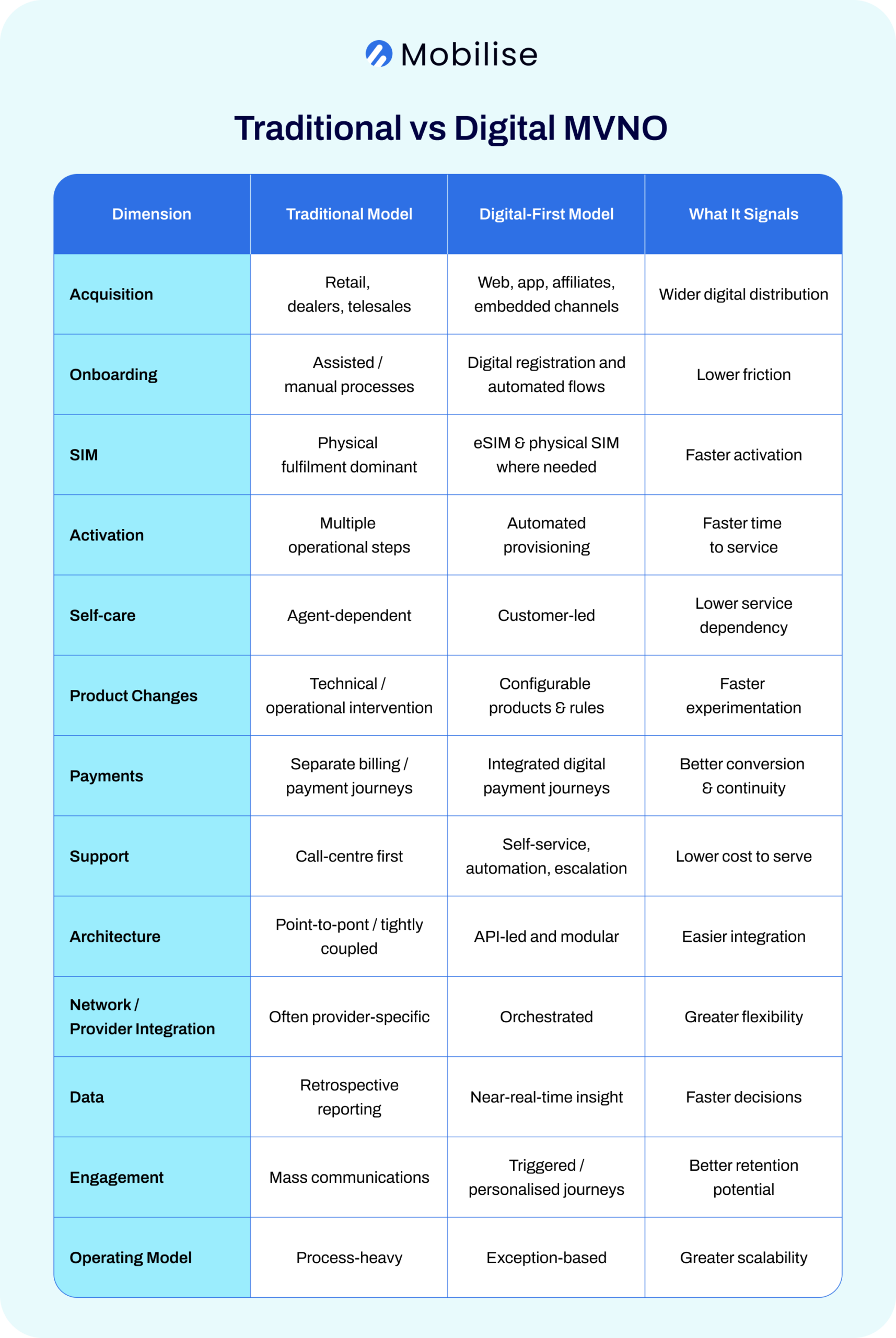
Digital MVNO vs Traditional MVNO
There is naturally significant overlap between the two models, and many established MVNOs are already moving towards digital-first operations. The difference becomes clearer when we compare how the business actually works.
Digitising the Front Door Is Not Enough
This is where I think some digital transformation programmes get stuck.
The customer-facing experience gets redesigned. A new app is launched. The website looks modern.
But behind that experience, employees may still be manually moving information between systems, resolving provisioning failures, processing refunds, changing subscriptions or correcting customer accounts.
The result is a digital front end sitting on top of a largely traditional operation.
That can create an interesting contradiction: the customer expects an instant digital experience because the interface looks digital, but the organisation is unable to consistently deliver one because the processes behind it are not.
A genuinely digital MVNO needs to ask: “What happens after the customer presses the button?” If every digital action creates a manual task somewhere else, the journey has not really been digitised. It has simply moved the point at which the manual work begins.
The Customer Lifecycle Should Be Digital End to End
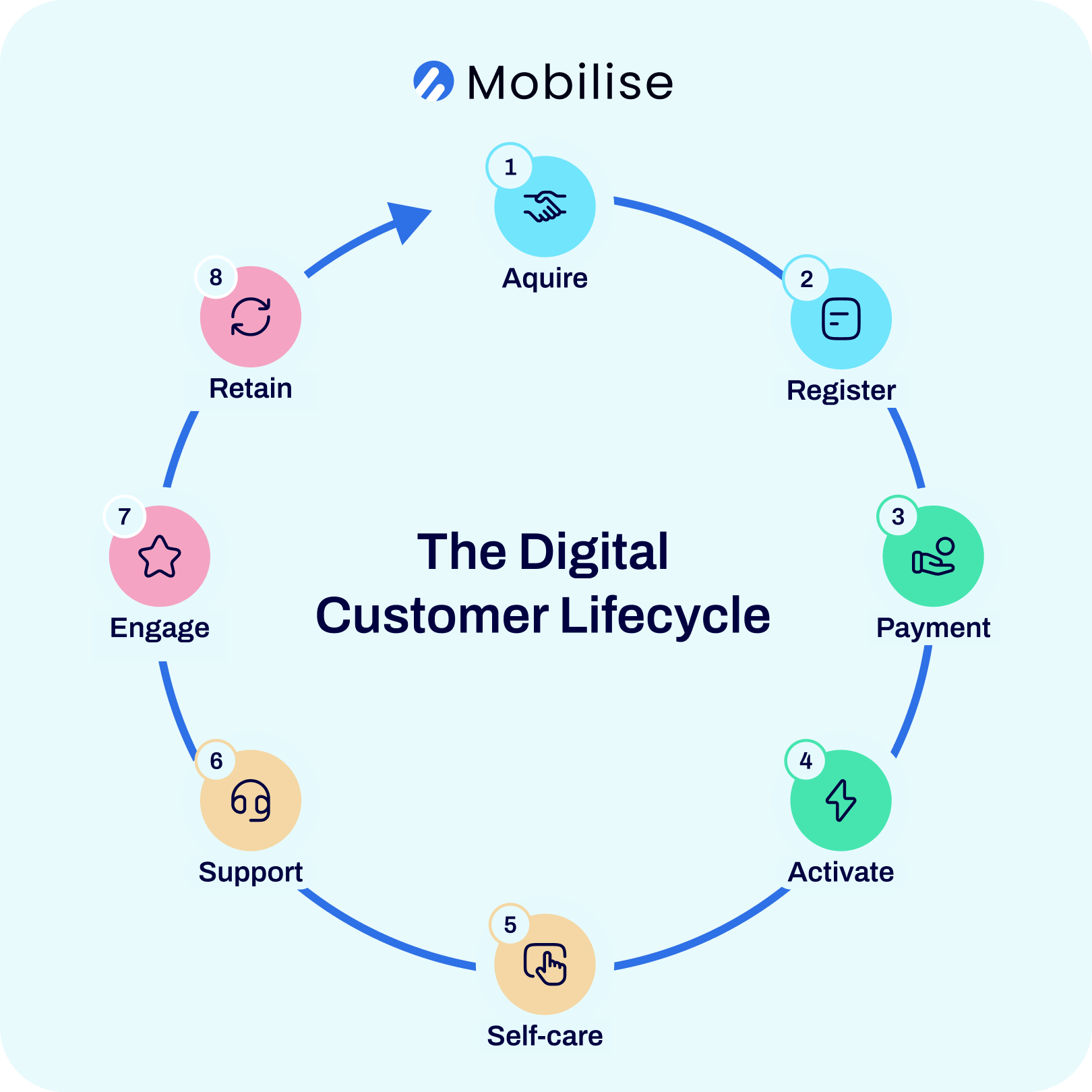
1. Discovery and Acquisition
Can customers discover relevant products digitally?
Can the MVNO support digital advertising, affiliates, referrals, comparison platforms and partner channels?
Can offers be tailored by customer, market or channel without rebuilding the proposition every time?
Digital acquisition should connect directly into the rest of the customer journey rather than ending with a lead that someone needs to process manually.
2. Registration and Identity
Can customers create an account without speaking to an agent?
Where identity verification or SIM registration is required, can those steps be incorporated directly into onboarding?
A digital MVNO should make compliance part of the journey rather than treating it as a separate operational process.
3. Purchase and Activation
This is where eSIM has become particularly important. A physical SIM creates logistical dependencies: inventory, distribution, delivery and often manual handling. eSIM can remove much of that friction by allowing the subscription to be delivered digitally.
The GSMA reported in 2026 that 73% of mobile network operators had launched commercial eSIM for smartphones. That makes digital provisioning a much more realistic foundation for large-scale digital journeys than it was only a few years ago. [2]
eSIM does not automatically make an MVNO digital. An operator can offer eSIM and still have fragmented onboarding, manual support and disconnected operational systems. Equally, a digitally mature MVNO may continue supporting physical SIMs where customers or markets require them.
eSIM is an enabler of the digital operating model, not the definition of it.
4. In-Life Customer Management
Launching the customer is only the beginning. Once active, subscribers expect to be able to manage their service themselves.
- Viewing usage and balances
- Buying add-ons
- Changing plans
- Updating payment methods
- Managing auto-renewal
- Recharging or topping up
- Managing multiple lines
- Replacing or transferring SIMs
- Viewing transactions
- Raising and tracking support requests
These may look like relatively simple app features, but each customer action can touch several backend systems. This is why orchestration becomes so important.
The customer should not need to understand whether an action involves a CRM, charging system, payment provider, MNO, eSIM platform or another third-party service. They should simply see the result.
5. Support and Troubleshooting
Digital does not mean removing human support. It means using human support where it adds value.
Common issues should increasingly be resolved through self-service, automated workflows, contextual guidance or AI-assisted support. Complex cases can then move to an agent with the relevant customer, service and transaction context already available.
For the customer, that means less friction. For the MVNO, it means operational teams can concentrate on exceptions rather than repetitive processes.
6. Retention and Growth
A digital MVNO should also be able to use customer and usage data to improve the proposition.
This is an important difference between simply digitising operations and becoming a digital product business. The platform is no longer only administering subscribers; it is helping the business understand and improve the customer relationship.
- Personalised offers
- Usage-triggered add-ons
- Plan recommendations
- Renewal journeys
- Referral programmes
- Loyalty propositions
- Churn identification
- Win-back campaigns
- Travel or roaming propositions
Digital Experience Is Now Part of the Product
For a digital MVNO, customer experience is not separate from the connectivity proposition. It is part of it.
JD Power’s 2026 U.S. Telecom Digital Experience Study found that apps and websites have become primary channels for paying bills, checking usage and making service changes. Among wireless customers, mobile-app login satisfaction was 38 points higher than website login satisfaction, while the overall satisfaction difference between apps and websites was 25 points. JD Power highlighted authentication, performance, navigation and visibility of account information as important contributors to the difference. [5]
Digital transformation is not about moving an existing process onto a screen. It is about redesigning the process so that it becomes easier for the customer.
Note: JD Power figures above relate to U.S. wireless customers and should be labelled as such in any visual.
The Back-End Matters as Much as the App
For product leaders, this is probably the most important part of the conversation. A great digital customer experience requires a flexible operating architecture behind it.
API-led integration
Capabilities should be accessible through APIs so the MVNO can integrate networks, payment services, identity providers, eSIM platforms, customer channels and third-party products without rebuilding the entire stack.
Orchestration
Business logic should sit above individual suppliers and systems. This allows the MVNO to manage how different technologies work together while reducing dependency on any single integration.
Modular architecture
Not every MVNO requires exactly the same technology. A modular model allows capabilities to be introduced or replaced as the proposition evolves.
Automation
Customer and operational events should trigger workflows automatically wherever appropriate.
Real-time data
Product, operational and customer teams increasingly need visibility into what is happening now rather than relying only on retrospective reports.
These capabilities are not as visible as the mobile app, but they are often what determines whether the experience inside the app actually works.
A Simple Test: How Digital Is Your MVNO?
Digital maturity is a spectrum, not a label. A more useful test is how much friction, manual intervention and architectural dependency has been removed from the complete operating model.
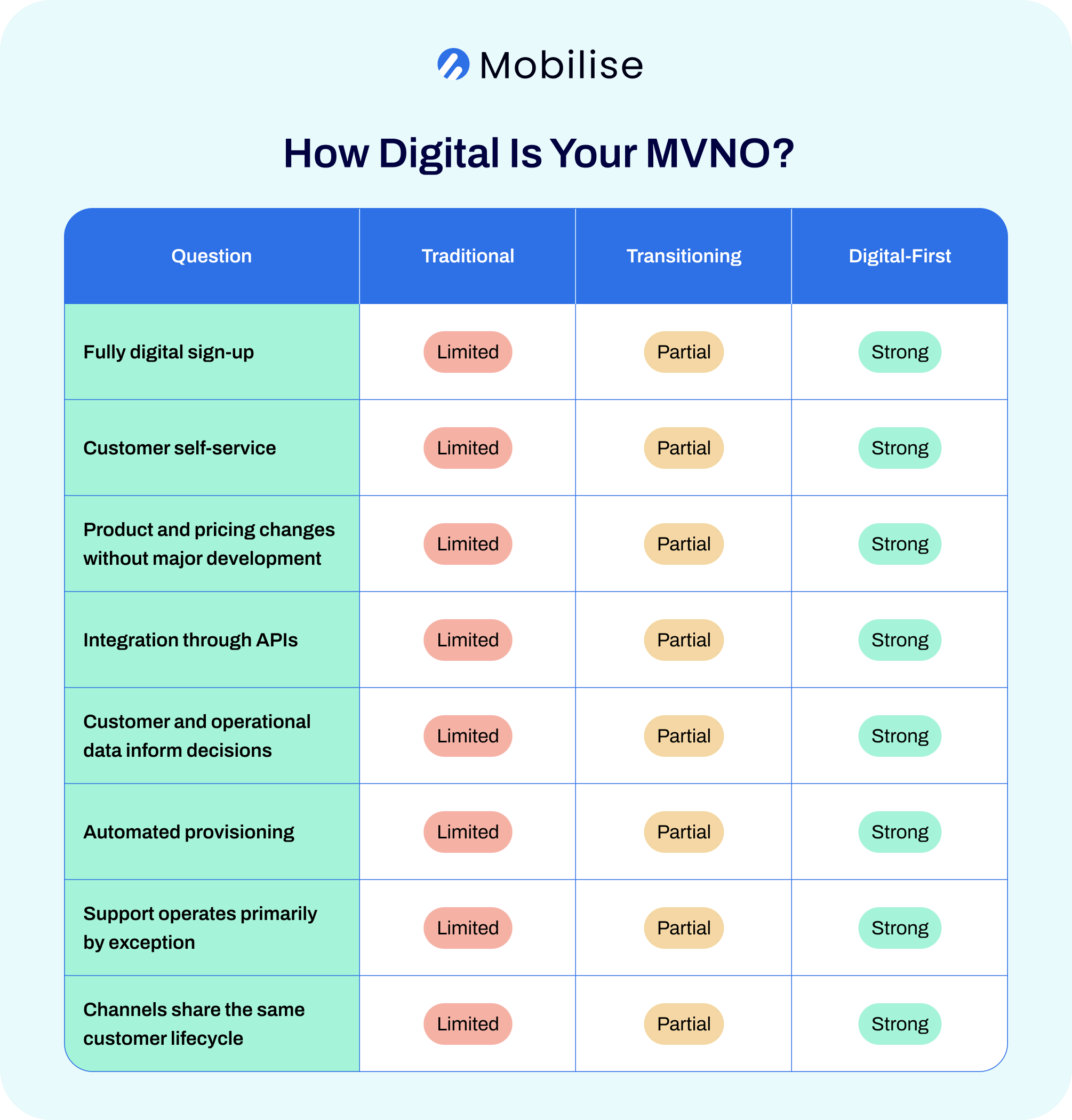
Instead of defining a digital MVNO by a feature checklist, product teams can ask five practical questions:
- Can a customer join without human intervention — from discovery through registration, payment and activation?
- Can customers manage most of their lifecycle themselves — including purchases, service changes, payments and common support scenarios?
- Can the business change the proposition without major development — including pricing, products, promotions and journeys?
- Can the platform integrate new partners and services easily as the ecosystem evolves?
- Can operational data influence product decisions continuously?
Digital Does Not Mean Technology for Technology’s Sake
The objective is not to automate everything because automation sounds modern. Every digital capability should improve at least one meaningful outcome.
- Reduce onboarding friction
- Increase conversion
- Lower cost to serve
- Improve activation success
- Reduce avoidable support contacts
- Accelerate new product launches
- Improve retention
- Enable expansion into new markets
- Create new revenue opportunities
The best digital MVNO is not necessarily the one with the most technology. It is the one where technology most effectively supports the business model and customer proposition.
Why the Lifecycle Matters Commercially
The business case for digital does not stop at acquisition. Deloitte’s 2026 Global Telecommunications Industry Outlook cites annual churn rates of around 22% across telecom providers, while up to 77% of consumers report no loyalty to their provider and only 47% remain with their primary telecom operator for more than five years. [6]
Those figures are broader telecom indicators rather than MVNO-specific benchmarks, but they reinforce an important point: acquisition is only one part of the product challenge.
For a digital MVNO, activation, self-care, support, payments, engagement and retention need to work as one connected experience.
Source scope: Deloitte global telecom outlook; figures are not specific to MVNOs.
How Mobilise Approaches the Digital MVNO Model
At Mobilise, our view is that a digital MVNO needs more than a customer-facing application.
The HERO® MVNO Platform is designed around the wider customer and operational lifecycle, bringing together the orchestration layer, CRM and digital self-care experiences required to manage a connectivity proposition.
Depending on the operating model, this can include capabilities across:
- Digital onboarding and customer management
- eSIM and SIM lifecycle management
- Product and plan management
- Payments and top-ups
- Customer self-care
- Support and ticketing
- Notifications and engagement
- Reporting and analytics
- Third-party and network integrations
The orchestration layer plays an important role because the customer journey rarely exists within one system. A purchase may involve the customer interface, payment provider, CRM, connectivity provider and provisioning platform.
HERO® manages the business processes between these systems so that the underlying complexity does not become the customer’s problem.
For organisations with their own digital channels, the HERO® API Suite can also expose connectivity capabilities into an existing ecosystem rather than requiring every experience to use a standard frontend.
The objective is not simply to digitise an MVNO. It is to provide an architecture that allows the MVNO proposition itself to continue evolving.
Final Thoughts
A digital MVNO is not an MVNO with an app. And it is not an MVNO with eSIM.
Those are important components, but they are only parts of a much bigger model.
The real transformation happens when the complete business is designed around digital customer journeys, automation, self-service, flexible architecture and data.
That matters because customers increasingly judge mobile providers against the digital experiences they receive from banks, travel platforms, retailers and technology companies.
They do not care how many systems sit behind an activation. They care whether it works.
For product leaders, the question is no longer: “What digital channels should our MVNO have?” It is: “How do we design an MVNO that behaves like a digital product business?”
That is a much bigger change than launching an app. Ultimately, it is the difference between digitising an existing telecom model and building a genuinely digital MVNO.
Frequently Asked Questions
What is a digital MVNO?
A digital MVNO is a mobile virtual network operator that designs its customer journeys and operating model around digital channels, automation, self-service, APIs and data. It still relies on an underlying mobile network but aims to digitise more of the customer lifecycle and operational processes.
What is the difference between a digital MVNO and a traditional MVNO?
The primary difference is the operating model. Traditional MVNO models may rely more heavily on physical distribution, manual processes, call centres and tightly coupled telecom systems. A digital MVNO typically places greater emphasis on online acquisition, automated onboarding, self-service, eSIM, APIs, orchestration and digital customer lifecycle management. The two models are not mutually exclusive, and many established MVNOs are progressively moving towards digital-first operations.
Does a digital MVNO need eSIM?
No. eSIM can significantly improve digital onboarding and activation, but it is not a requirement for an MVNO to operate digitally. A digital MVNO may support both eSIM and physical SIM depending on its customers and target markets.
Is an app enough to make an MVNO digital?
No. An app is only one customer channel. If processes behind the app still depend heavily on manual intervention or disconnected systems, the underlying operating model may remain largely traditional.
What technology does a digital MVNO need?
Requirements vary, but commonly include customer management, product management, billing or charging integration, payments, SIM/eSIM provisioning, self-care, support, reporting, analytics and integration with the underlying connectivity provider. API-led architecture and orchestration can help these components work together.
Can an existing MVNO become a digital MVNO?
Yes. Digital transformation does not necessarily require replacing every existing system. MVNOs can progressively introduce digital customer journeys, APIs, orchestration, automation, eSIM and modern self-care capabilities around existing telecom infrastructure.
What are the benefits of a digital MVNO?
Potential benefits include faster customer onboarding, lower operational effort, better self-service, quicker product changes, improved customer insight and greater flexibility to introduce new services or enter new markets. The actual business case depends on the MVNO’s proposition, scale and target customers.
References
[1] Juniper Research – MVNO in a Box Platforms to Drive MVNO Market to 438 Million Subscribers Globally by 2030
https://www.juniperresearch.com/press/mvno-in-a-box-platforms-to-drive-mvno-market/
[2] GSMA – eSIM mass market deployment moves from forecast to fact
https://www.gsma.com/solutions-and-impact/technologies/esim/gsma_resources/esim-mass-market-deployment-moves-from-forecast-to-fact/
[3] Counterpoint Research – G+D, Thales and Valid Emerge as ‘Pacesetters’ in eSIM Enablement CORE Report 2026
https://counterpointresearch.com/en/insights/gd-thales-and-valid-emerge-as-pacesetters-in-esim-enablement-core-report-2026
[4] GSMA – From Ambition to Execution: How Open Gateway Is Scaling the Global API Economy
https://www.gsma.com/newsroom/article/from-ambition-to-execution-how-open-gateway-is-scaling-the-global-api-economy/
[5] JD Power – 2026 U.S. Telecom Digital Experience Study
https://www.jdpower.com/business/press-releases/2026-us-telecom-digital-experience-study
[6] Deloitte – 2026 Global Telecommunications Industry Outlook
https://www.deloitte.com/us/en/insights/industry/technology/technology-media-telecom-outlooks/telecommunications-industry-outlook.html


 ChatGPT