









Introduction
When eSIM was introduced to the consumer market in 2016, it promised to revolutionise the way people connect to mobile networks. Instead of relying on a physical SIM card, consumers could activate a mobile plan digitally, switch providers more easily, and manage multiple connectivity profiles on a single device.
Almost a decade later, eSIM is no longer a future-facing concept. It’s already supported by many smartphones, tablets, laptops, and wearables. Operators are expanding their eSIM services, travel eSIM adoption is growing, and more consumers are becoming familiar with digital-first connectivity. However, consumer eSIM awareness still has a long way to go.
This blog explores the current state of eSIM awareness in 2026, why consumer understanding remains imbalanced, and what this means for mobile operators and businesses looking to offer digital connectivity services.
TL;DR
- eSIM awareness is growing, but consumer understanding is still inconsistent.
- GSMA Intelligence surveys show eSIM awareness has risen from 25% to 60%, but only 8% of aware consumers discover eSIM through their operator’s own commercial push.
- A Proximus Global and YouGov survey found that only 33% of consumers across the US, UK, and China know what an eSIM is, while 42% are unsure whether their phone supports one.
- UK eSIM awareness has improved significantly, with nearly three-quarters of consumers having heard of eSIM, up from 27% in 2022.
- Consumer eSIM adoption is accelerating, with global eSIM shipments reaching 605 million in 2025 and consumer eSIM profile downloads increasing by 43%.
- Travel eSIM is becoming one of the strongest drivers of consumer interest, especially as people look for easier, more affordable ways to stay connected abroad.
- To turn awareness into adoption, operators and service providers need to explain eSIM more clearly, simplify activation, and promote it as a practical, everyday service rather than a technical feature.
eSIM Awareness – Past and Present
Past
For years, consumer eSIM awareness increased at a slower pace than what the telecom industry anticipated.
The technology was introduced to the consumer market in 2016. For a long time, it remained a feature exclusive to flagship devices and was associated with early adopters and specific use cases such as smartwatches. Many consumers either hadn’t heard of eSIM or didn’t realise that their own device already supported it.
This created a gap between availability and adoption. Device manufacturers were adding eSIM capability, operators were beginning to support eSIM activation, but consumers were not always being educated on what the technology was, how it worked, or why they should use it.
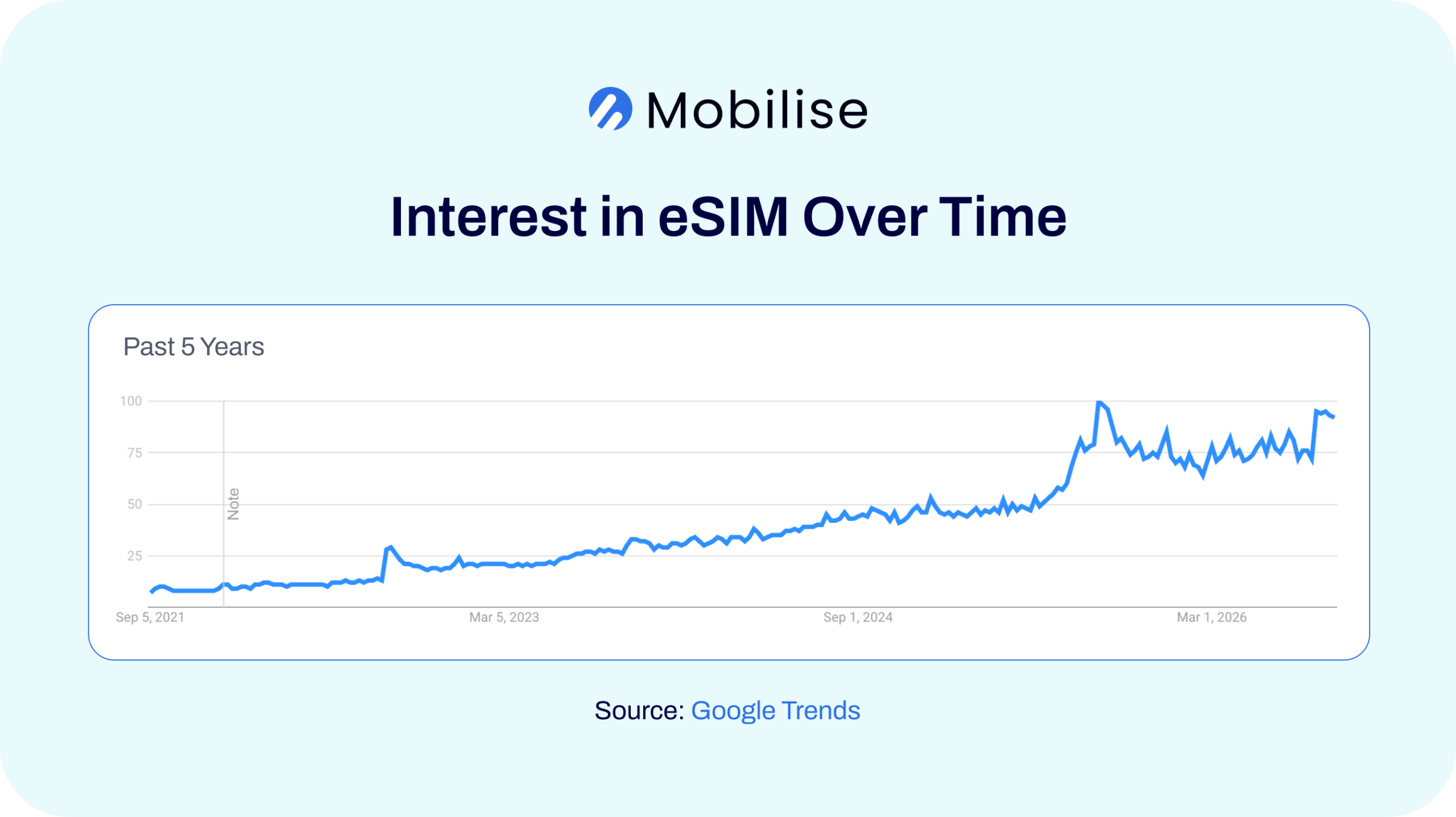
Apple’s launch of the eSIM-only iPhone 14 in the US in 2022 became one of the biggest turning points. It pushed eSIM into mainstream industry conversation and forced more operators to review their eSIM readiness. It caused almost double the interest in search results related to eSIM and increased consumers’ appetites for eSIM services, with consumer eSIM profile downloads surging by 130% in 2022, according to the Trusted Connectivity Alliance.
The industry was forced to adapt quickly to the changes. Since then, there’s been significant progress in consumer awareness of eSIM.
eSIM has become a more visible part of the mobile market, particularly in countries where device support, operator availability, and digital-first buying habits are already strong. But awareness and understanding are growing unevenly across regions.
Present
In 2026, eSIM awareness is moving in the right direction, but consumer understanding still receives mixed responses.
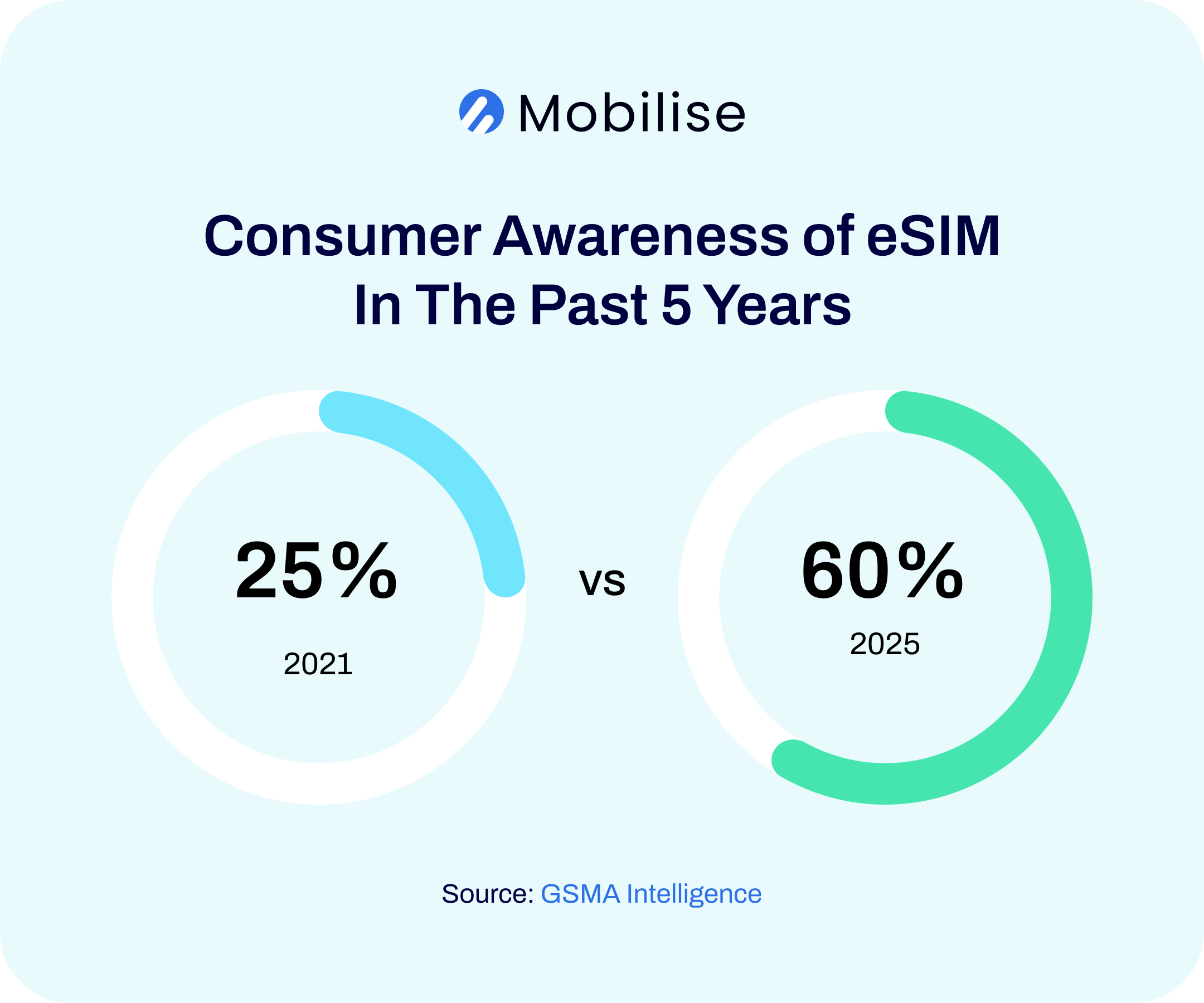
On one hand, eSIM awareness is clearly growing. Research by GSMA Intelligence has found that consumer eSIM awareness increased from 25% in 2021 to 60% in 2025. It also found that 54% of consumers are interested in using eSIM, a shift largely driven by the rise of travel eSIM.
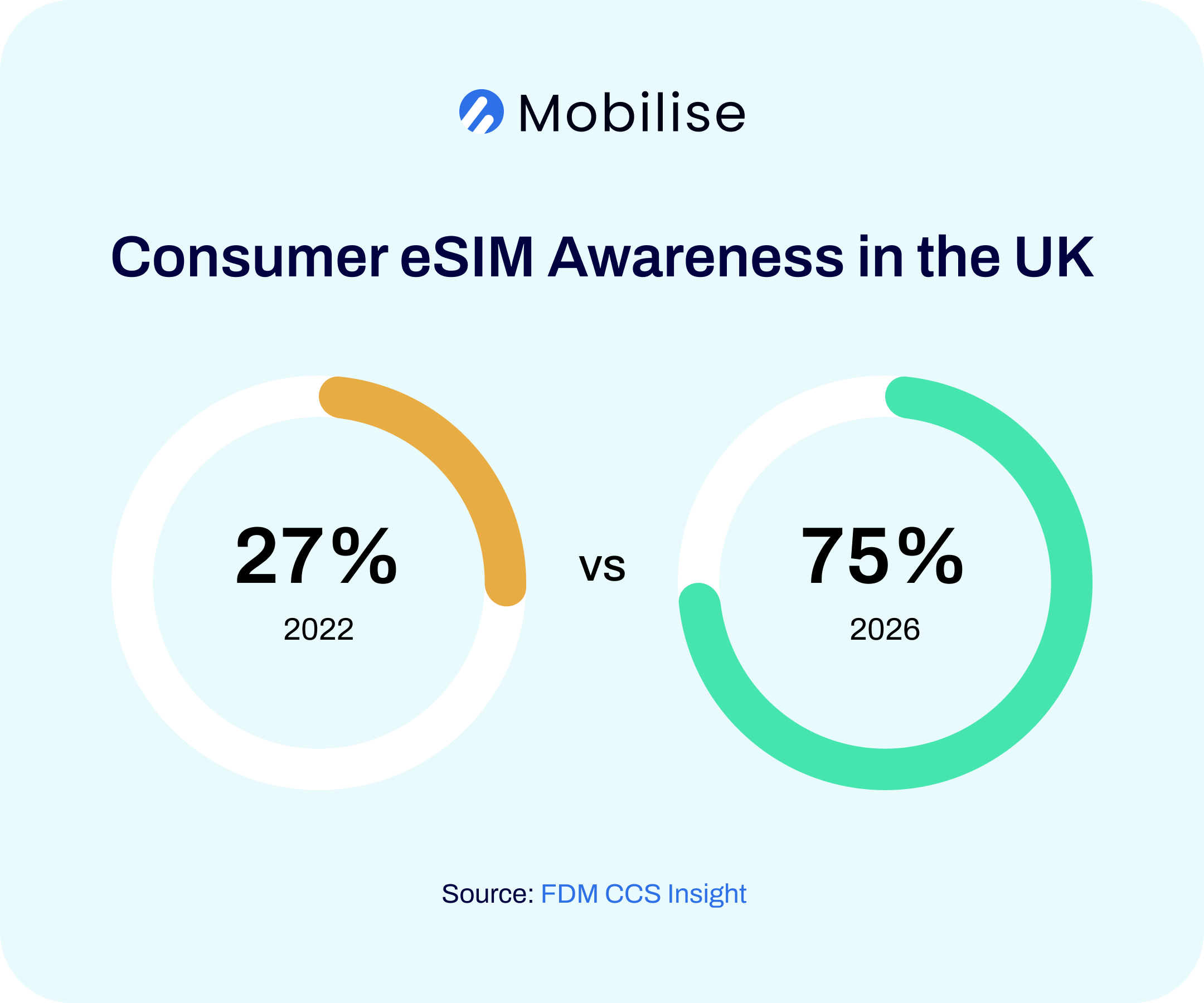
Supporting this, FDM CCS Insight found that across the nationally representative sample of more than 1,000 respondents, nearly three-quarters said they had heard of eSIM, up from just 27% in the 2022 survey.
The shift in awareness is significant. eSIM is becoming part of the wider consumer conversation around mobile plans, roaming, digital activation, and connected devices. However, awareness doesn’t automatically equal understanding.
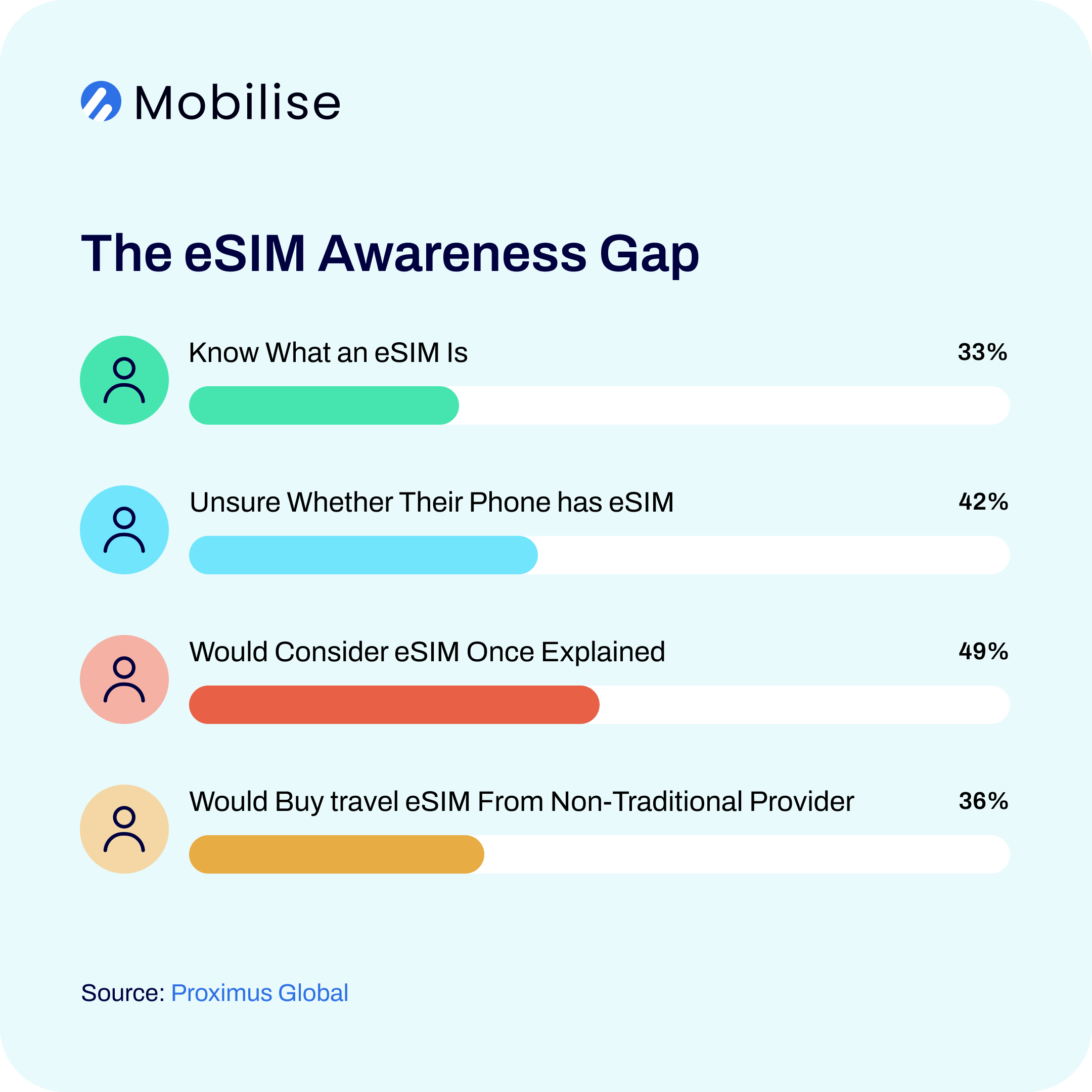
Proximus Global’s research with YouGov found that only 33% of consumers across the US, UK, and China are aware of what an eSIM is, while a further 21% have heard of eSIM but don’t understand what it is. 42% of respondents are unsure whether their phone has eSIM capability.
That uncertainty is a key factor in this case. If consumers aren’t sure whether their phone supports eSIM, they’re unlikely to request it, activate it, or choose a provider based on it. For many people, the physical SIM card remains the default, even when a digital alternative is available.
The UK shows how quickly the market can move when awareness improves. CCS Insight found that almost a third of UK consumers who had heard of eSIM had used it to sign up with a UK provider. It also found that almost a quarter of consumers had used a travel eSIM provider, rising to 32% among those who had been on holiday abroad in the past three years.
In the US, Apple’s move to make their lineup eSIM-only forced the operators, market and consumers to adapt to the change.
Travel eSIM is especially important in the current market. For many consumers, it is the first time eSIM feels like a clear solution to a real problem: staying connected abroad without relying on expensive roaming, physical SIM swaps, or store visits. Once consumers understand the use case, interest increases. Proximus Global found that 49% of consumers across the US, UK, and China would consider using an eSIM when travelling abroad after the technology was explained to them.
The challenge for operators, OEMs, and digital connectivity providers is no longer simply making eSIM available. The challenge is making it understandable, visible, and easy to activate.
In 2026, consumer eSIM awareness is improving, but the education gap remains. The next stage of adoption will depend on how well the industry explains the benefits of eSIM and makes digital connectivity feel simple, practical, and relevant to everyday users.
The Reasons for Low Consumer Awareness of eSIM
Although eSIM awareness has improved, many consumers still don’t fully understand what an eSIM is, how it works, or whether it’s already available on their device. This remains one of the biggest barriers to wider consumer eSIM adoption.
According to Proximus Global research conducted with YouGov, only 33% of consumers across the US, UK, and China know what an eSIM is. A further 21% have heard of eSIM but do not understand it, while 42% are unsure whether their phone is equipped with one.
This indicates that the problem extends beyond just eSIM availability, as many devices already support eSIM. The real challenge is that consumers often remain unaware of this support.
Device support has grown significantly. In 2025, Trusted Connectivity Alliance reported a record number of devices certified with Remote SIM Provisioning capability for consumer eSIMs, including 107 smartphone models and 199 devices in total.
Despite this, eSIM still doesn’t always feel visible to the everyday consumer. In many cases, the customer journey still centres on the physical SIM. Consumers signing up for a new mobile plan may still be offered a plastic SIM by default, while the eSIM option is hidden in the settings, help centre, or FAQ section.
This creates a disconnect in which the device may support eSIM, and the operator may offer it, but the consumer may still not know it’s an option.
Another reason for low consumer awareness of eSIM is limited promotion by operators. GSMA Intelligence surveys found that consumer eSIM awareness has climbed from 25% to 60%, but only 8% of aware consumers discover eSIM through their operator’s own commercial push.
Operators continue to be among the most trusted sources of mobile service information. If consumers don’t hear about eSIM from their provider, they’re more likely to learn about it through travel brands, app-based providers, online articles, social media, or word of mouth.
There’s also still a perception issue. For many consumers, the physical SIM card is familiar. It is something they understand. They know it arrives in the post, slots into the phone, and connects them to the network.
eSIM, by comparison, can still sound technical. Terms like “profile”, “QR code”, “remote provisioning”, and “SM-DP+” make sense to the telecom industry, but they do not mean much to the average mobile user. If eSIM is explained as a technical feature rather than a simple way to activate mobile connectivity, many consumers won’t immediately see the benefit.
Activation can also be a barrier. Mobile World Live’s eSIM Survey Report found that 55% of industry respondents viewed lack of awareness as a key barrier to consumer eSIM adoption. Other barriers included lack of device support at 47%, fear of adopting new technology at 39%, and complicated activation at 35%.
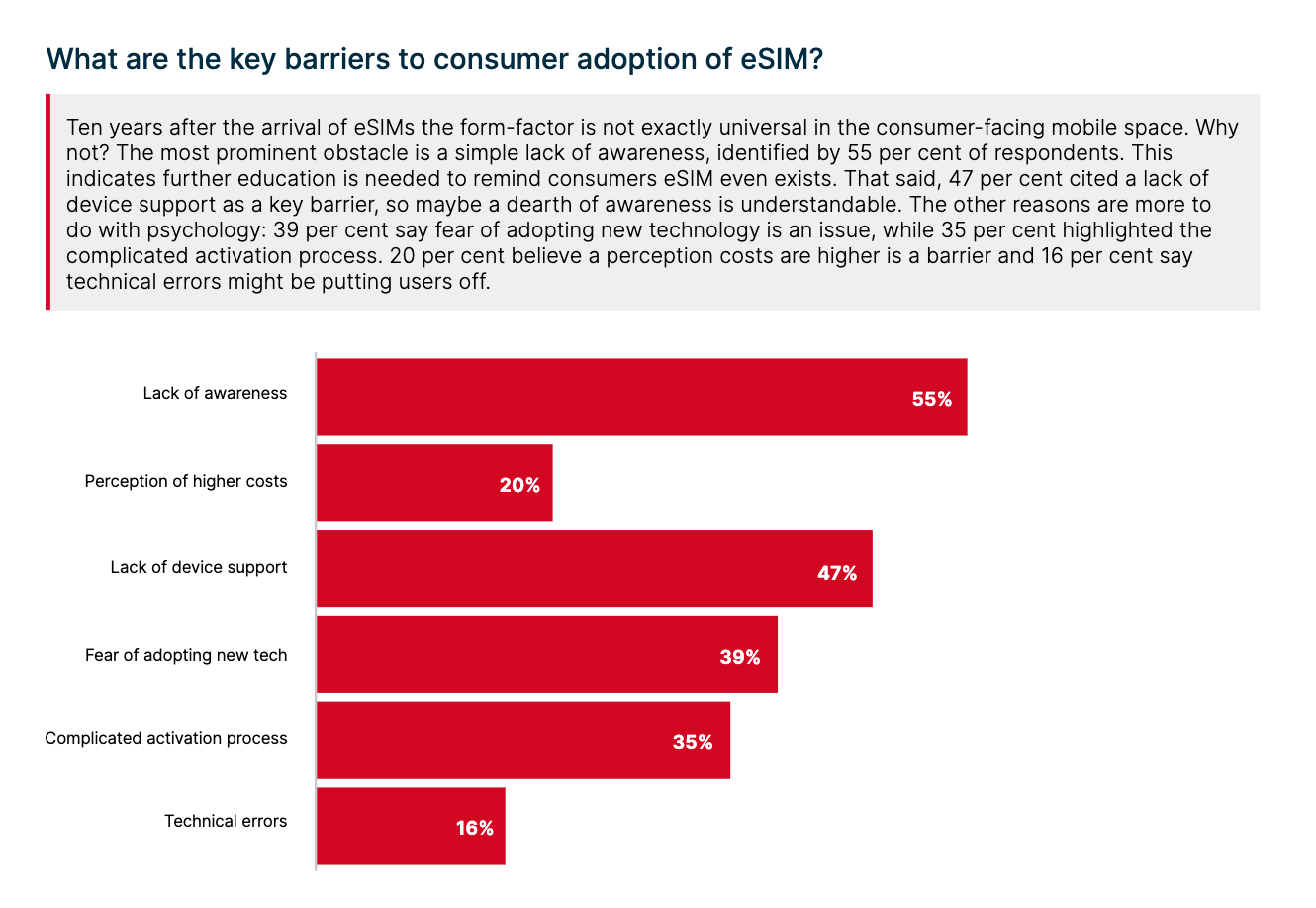 Source: Mobile World Live
This emphasises that awareness and experience are closely linked. Even if a consumer has heard of eSIM, a confusing activation process can still put them off. If they’re worried about losing their number, making a mistake, or being left without service, they may opt for the physical SIM simply because it feels safer.
There are also operational reasons why eSIM isn’t always promoted effectively. Mobile operators need the right infrastructure, support teams, onboarding flows, customer communications, and device compatibility checks in place. Without these, promoting eSIM too heavily can increase pressure on customer service teams.
The same Mobile World Live Report found that operators and ecosystem players also face behind-the-scenes rollout challenges, including partner coordination, technical integration, customer resistance, and backend process upgrades.
This means the awareness problem is a combination of a marketing problem, a product problem, an operations problem, and a customer experience problem.
For consumer eSIM awareness to improve, the industry needs to make eSIM easier to understand and easier to use. Operators, OEMs, travel brands, and digital connectivity providers need to explain the benefits in everyday language, guide users through activation, and show clear use cases.
Consumers don’t need to understand the technology behind eSIM. They need to understand what it helps them do.
RECOMMENDED READING


The Implications of Low Consumer Awareness of eSIM
Low consumer awareness of eSIM has consequences for consumers, operators, OEMs, and businesses looking to offer digital connectivity services.
For consumers, the most obvious impact is missing out on the benefits of eSIM. These include faster activation, easier switching, support for multiple profiles, simpler travel connectivity, and less reliance on physical SIM cards.
For example, travel eSIM has become one of the clearest consumer use cases for eSIM. It allows travellers to buy and activate mobile data before or during a trip without visiting a store, swapping a SIM card, or relying only on roaming packages.
However, if consumers are unaware of eSIM, they’re less likely to search for it, compare it, or choose it when travelling.
Proximus Global’s research found that once eSIM was explained, 49% of consumers across the US, UK, and China said they would consider using one when travelling abroad. This suggests that demand exists, but it often needs to be unlocked through better education.
For operators, low eSIM awareness can slow down digital transformation. eSIM gives operators an opportunity to reduce physical SIM logistics, simplify onboarding, support digital-first acquisition, and deliver a better mobile customer experience. But these benefits are harder to realise if customers continue to default to physical SIMs.
Trusted Connectivity Alliance data shows that the market is already moving. Global eSIM shipments reached 605 million in 2025, up 18% year on year, while consumer eSIM profile downloads increased by 43%.
It’s clear that consumer adoption is growing, but operators need to make sure they’re part of that growth. If they don’t promote eSIM effectively, they risk allowing other brands to own the customer relationship around digital connectivity.
This is already visible in travel eSIM. GSMA Intelligence found that across 11 major countries surveyed, 12% of consumers who had travelled internationally in the previous 12 months used eSIM while abroad. More than 70% of those travellers used telco eSIM services, while the rest used travel eSIM services from non-telco providers. Mobile operators should view this as both a warning and an opportunity.
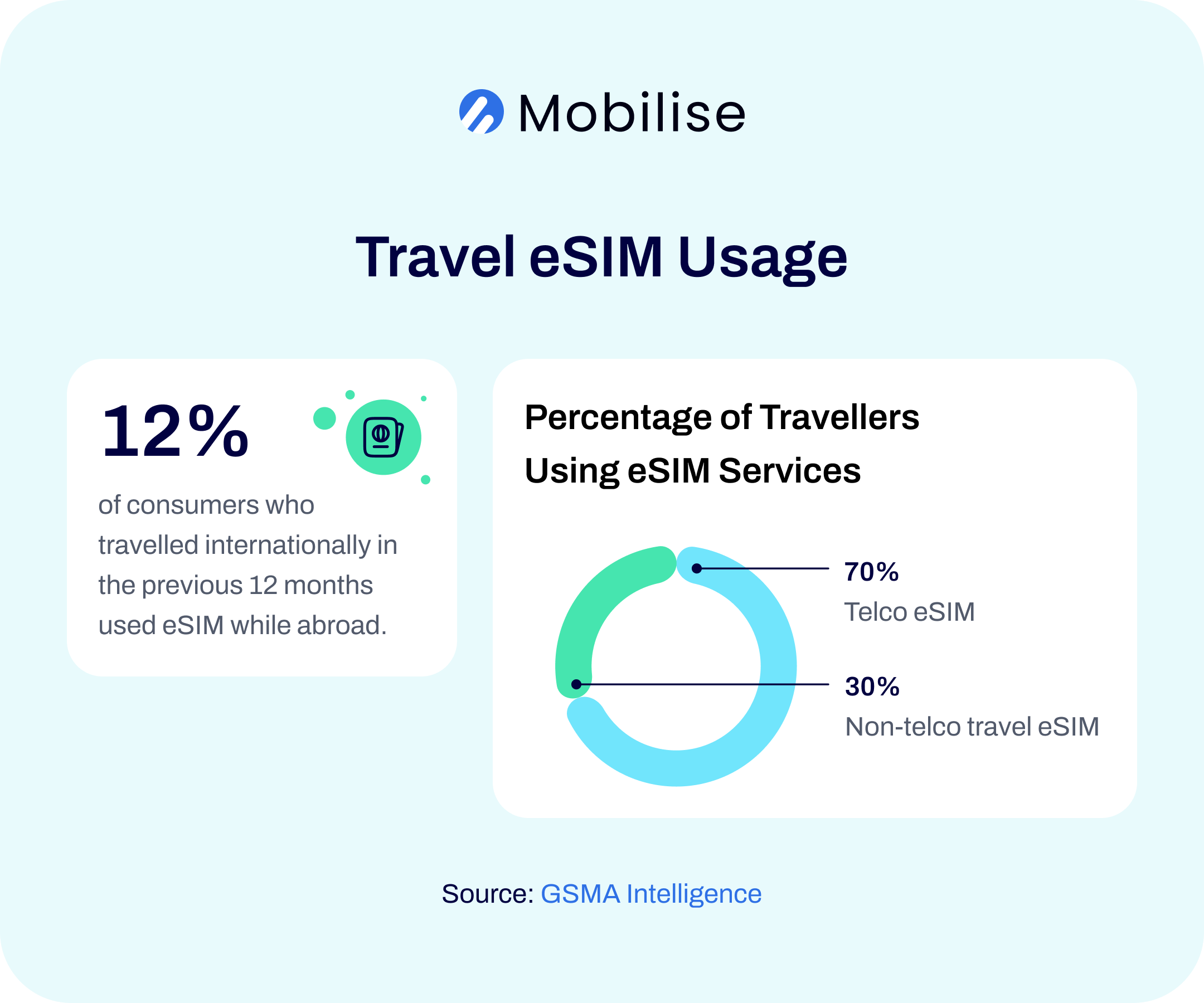
On one hand, travel eSIM providers are creating new competition in a space that was traditionally served through roaming. On the other hand, operators already have the network relationships, customer base, billing systems, and trust needed to offer strong eSIM propositions themselves. Operators still have a clear trust advantage.
Kaleido Intelligence found that 89% of travellers placed mobile operators among their top three preferred providers for buying an eSIM, compared with 60% selecting specialist travel eSIM providers. But that advantage needs to be converted into simpler, more visible digital travel offers.
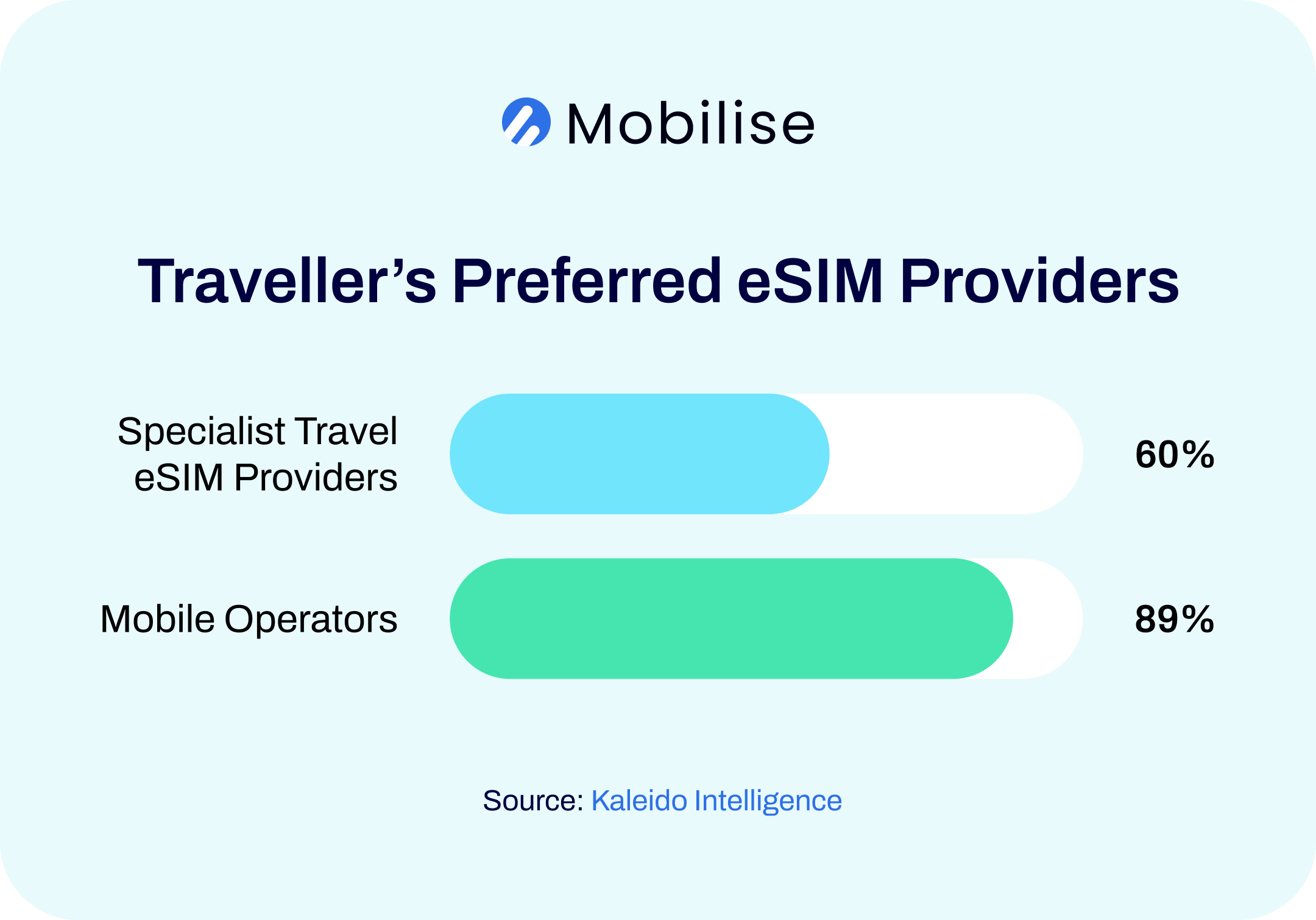
The concern isn’t that consumers won’t adopt eSIM, but that they might do so via third parties.
Low awareness also affects the customer experience. If a consumer doesn’t understand eSIM, they may feel uncertain during activation. They may worry about losing service, deleting the wrong profile, transferring to a new device, or being unable to contact support. That uncertainty can create friction in the onboarding journey. Instead of eSIM feeling like a simpler, faster alternative, it can feel like yet another tedious, technical step.
In fact, IDEMIA’s study found that 74% of MNOs, MVNOs and MVNEs report generally positive customer experiences with eSIM activation, but close to 50% still question the efficiency of their onboarding journeys.
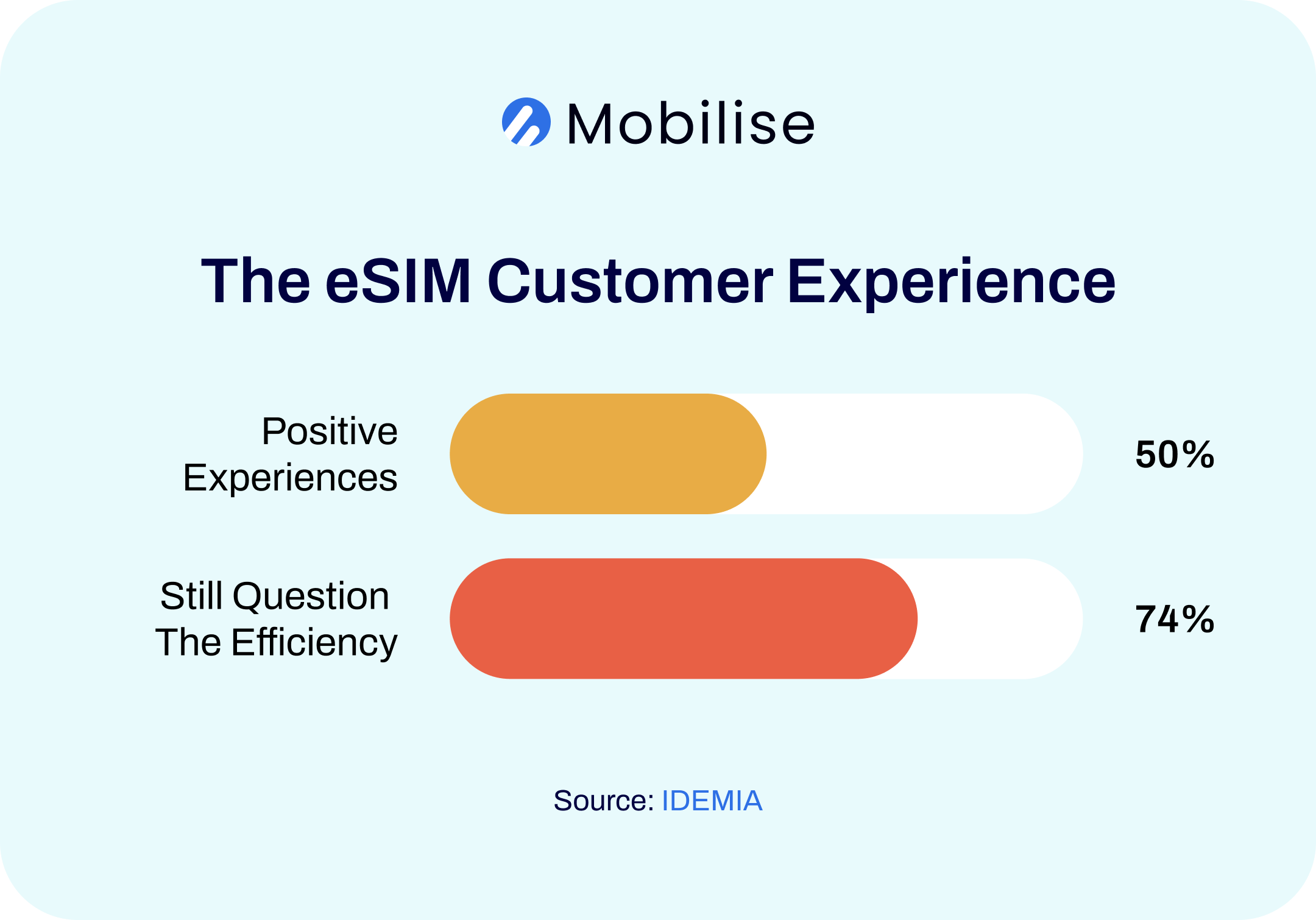
This is why operators need to treat eSIM as part of the full customer journey, not just as a SIM replacement. The experience needs to be simple from discovery to activation, usage, support, and renewal. There are also implications beyond telecom operators.
As eSIM becomes more familiar, businesses in travel, fintech, retail, and digital platforms have an opportunity to embed connectivity into their own customer journeys. Proximus Global found that 36% of consumers would consider buying a travel SIM package from a non-traditional provider, such as a supermarket, airline, or travel website.
This opens the door for new eSIM business models. Airlines can offer travel data before departure. Travel companies can add connectivity to booking journeys. Fintechs can support customers travelling abroad. Retailers can bundle mobile data into loyalty or subscription offers.
However, the same rule applies. The brands that succeed won’t be the ones that simply make eSIM available. They will be the ones that make it clear, relevant, and easy to activate.
In the long term, low consumer awareness could slow down the wider shift towards digital connectivity, but it won’t stop it. The market is already moving towards eSIM. The question is which companies will educate customers well enough to benefit from it.
eSIM Awareness – The Future
The future of eSIM awareness looks promising, but the next phase of growth will depend on how well the industry turns awareness into understanding and adoption.
The market has already moved far beyond early-stage interest. GSMA describes 2026 as a year of eSIM expansion, with mass-market deployment moving from forecast to fact. GSMA also notes that 73% of mobile network operators have launched commercial eSIM for smartphones, although many are still not doing enough to promote and activate it.
This shows that the eSIM ecosystem and infrastructure is maturing. More operators now support eSIM, more devices are eSIM-enabled, and more consumers are familiar with the technology. However, the customer journey still needs to become simpler, clearer, and more intuitive.
GSMA Intelligence forecasts that eSIM-enabled smartphone connections will reach 2.5 billion globally by 2028, with eSIM representing 42% of all SIM technologies by 2030.
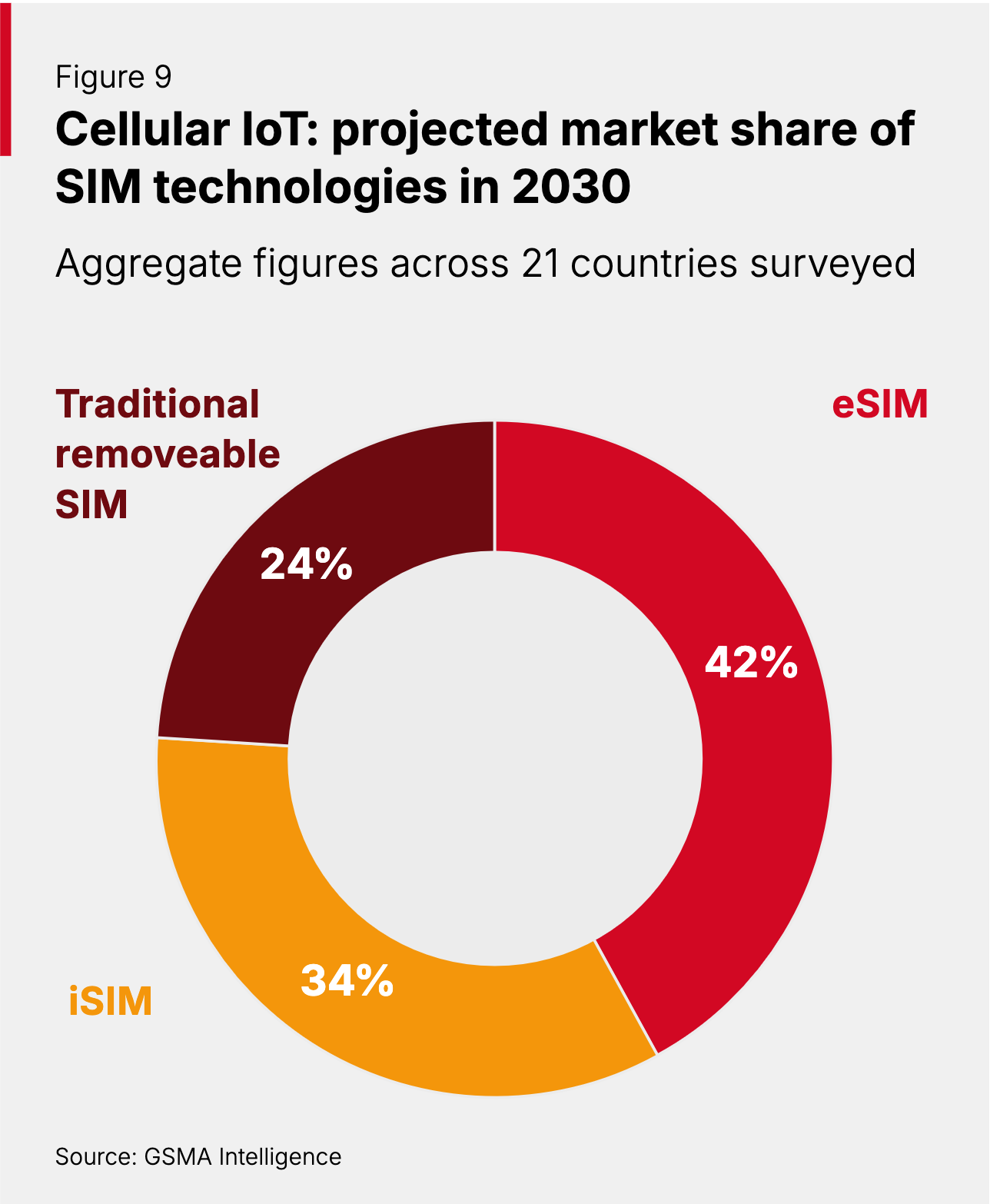 Source: GSMA Intelligence
This points to a future where eSIM becomes a standard part of mobile connectivity, not a niche feature. As more consumers buy eSIM-enabled phones, tablets, laptops, and wearables, they’ll become increasingly familiar with digital activation, multi-device connectivity, and more flexible ways to stay connected.
Travel eSIM will likely play a major role in this eSIM awareness growth.
For many consumers, travel is the moment where the value of eSIM becomes easiest to understand. They may not think about SIM technology in everyday life, but they do think about roaming charges, airport Wi-Fi, physical SIM swaps, and staying connected abroad.
CCS Insight expects global travel eSIM provisions to pass 280 million by 2030, up from around 70 million in 2024. It also expects the travel eSIM market to surpass $4.4 billion in value by 2030.
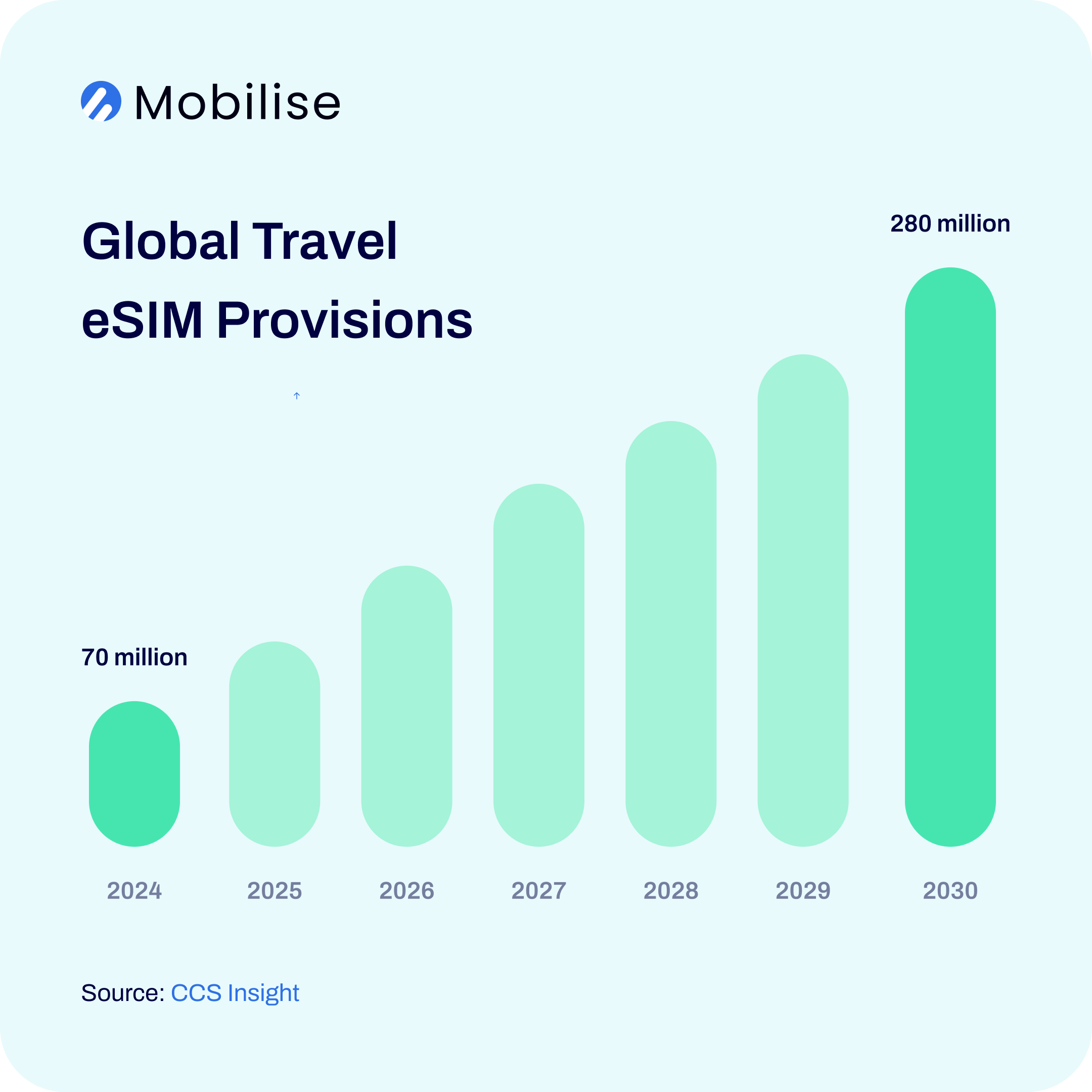
This growth will bring more consumers into contact with eSIM through real, practical use cases. Rather than being introduced to eSIM as a technical specification, consumers will experience it as a simple way to solve a familiar problem.
This is where awareness can turn into adoption.
It will also put more pressure on operators to improve their eSIM customer experience. As consumers become used to app-based travel eSIM providers, they may expect the same level of simplicity from their main mobile provider. Long activation journeys, unclear instructions, or physical SIM defaults will become harder to justify.
Juniper Research identified travel eSIM and MVNO convergence as one of the key telecoms and connectivity trends for 2026, alongside the streamlining of consumer eSIM provisioning to support wider market shifts.
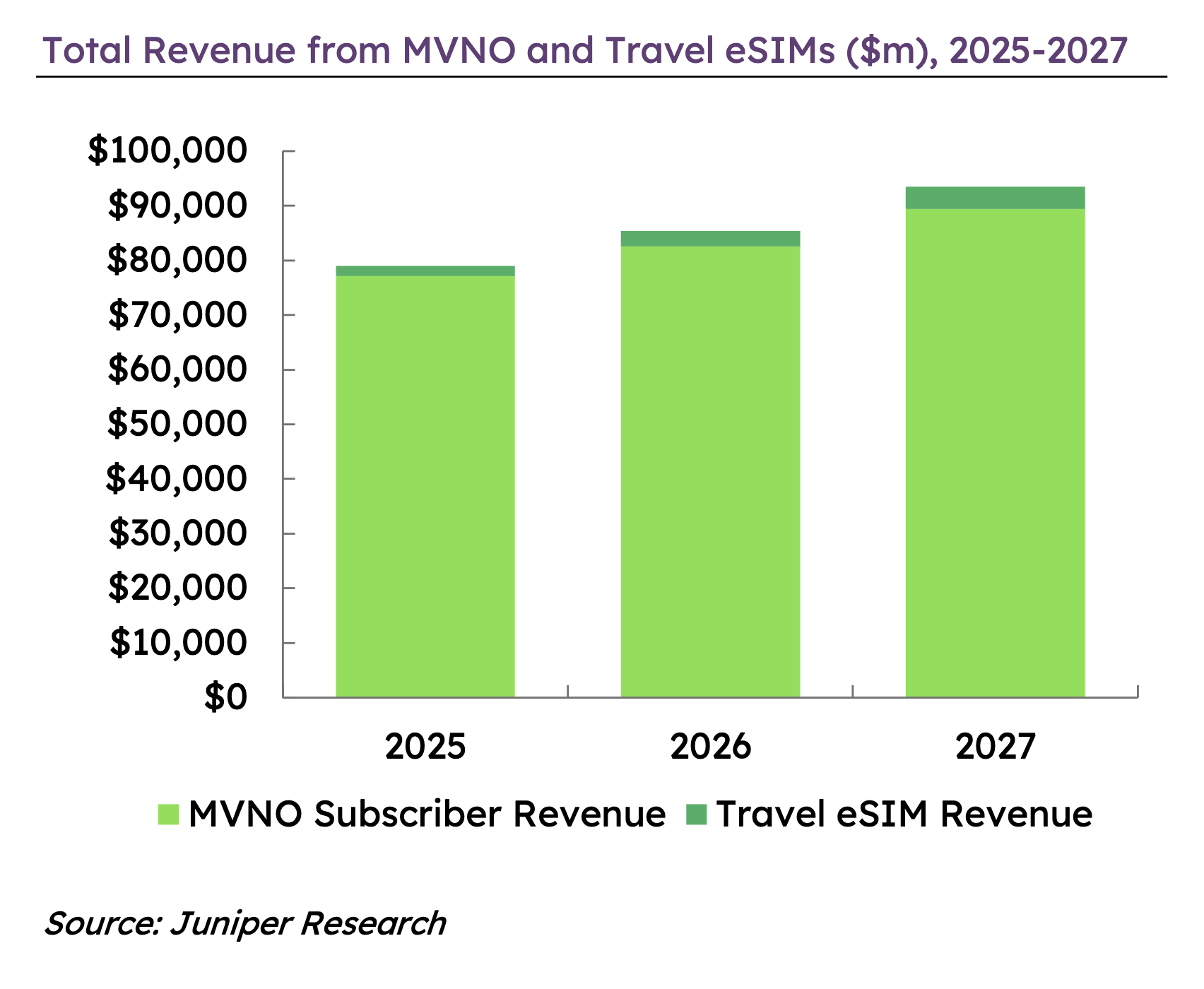 Source: Juniper Research
This suggests that eSIM will not only change how consumers activate mobile plans. It will also change who can offer connectivity.
As eSIM becomes easier to provision, more non-telco businesses will enter the market with embedded mobile services. Travel brands, digital banks, retailers, superapps, and online platforms can all use eSIM to add connectivity to their existing customer experiences. We’re already seeing this with the likes of Lidl and Revolut offering eSIM plans to their customers.
For operators, this makes eSIM awareness a much more critical concern. It’s not enough to wait for consumers to discover eSIM by themselves. Operators need to educate customers, promote the benefits of eSIM, simplify activation, and build propositions that compete with app-first challengers.
The future of consumer eSIM awareness will therefore be shaped by three things:
- Clearer education from operators, OEMs, and digital connectivity providers.
- Simpler activation journeys that reduce consumer uncertainty.
- Stronger use cases, especially around travel, multi-device connectivity, and digital-first mobile plans.
The more clearly eSIM is explained, the faster consumers will adopt it.
Conclusion
Consumer eSIM awareness has come a long way since the technology first entered the consumer market in 2016.
eSIM is now supported by more devices, offered by more operators, and used across more consumer journeys. Travel eSIM adoption is growing, eSIM profile downloads are increasing, and more people are beginning to understand the benefits of digital connectivity. However, the awareness gap hasn’t disappeared.
Many consumers still don’t know what eSIM is. Many are unsure whether their phone supports it. Others may have heard of eSIM, but do not yet understand why they should use it instead of a physical SIM card. This is the next challenge for the telecom industry.
The future of eSIM adoption won’t be driven by availability alone. It will be driven by education, simplicity, and customer experience. Consumers need to know that eSIM exists, understand how it benefits them, and feel confident activating it.
For operators, this is an opportunity to improve digital onboarding, reduce reliance on physical SIM logistics, and create more flexible customer journeys. For travel brands and digital platforms, it opens the door to connectivity services that can add value directly inside existing customer experiences.
The companies that succeed with eSIM will be those that make it feel less like a telecom feature and more like a simple, useful service.
In 2026, eSIM awareness is no longer just about whether consumers have heard of the technology. It’s about whether they understand it well enough to use it.
For more information on how Mobilise helps businesses deliver digital-first eSIM experiences, explore our HERO® solutions or get in touch with our team.