








Introduction
Build, buy or embed connectivity? Or is there a faster, simpler way to launch digital connectivity? For years, businesses looking to offer mobile connectivity had one obvious route: become an MVNO.
That approach made sense when connectivity was primarily treated as a stand-alone telecom product. Today, the picture is different. Connectivity can increasingly become a capability within an existing digital experience rather than requiring an entirely new telecom business around it.
Banks can add travel eSIM services to their mobile apps. Airlines can extend the customer journey beyond the flight. Travel companies can introduce connectivity as an additional service. Digital platforms can add mobile services without asking customers to leave the experience they already use.
This is where embedded connectivity becomes important.
Embedded connectivity allows a business to integrate mobile services — such as eSIM, data, voice or messaging — into an existing app, website or digital customer journey, typically through APIs, SDKs or other embedded components.
The question, therefore, is no longer simply: “How do we launch an MVNO?”
It is: “What is the right connectivity strategy for our business? Build, buy or embed connectivity?”
The answer depends on what role connectivity is expected to play, how quickly the proposition needs to launch, how much operational control the business wants and where it intends to go next.
Connectivity Has Become a Product Layer
Most successful digital businesses do not build every capability themselves.
They integrate payments, communications, mapping, identity, cloud infrastructure and other specialist services into their products through technology partners and APIs.
Connectivity is beginning to follow a similar model.
Rather than always being treated as a separate telecom proposition, it can become another digital product capability that sits inside an existing customer journey.
That opens the opportunity to organisations that historically may never have considered themselves part of the telecom industry, including:
- Banks and fintechs
- Travel brands
- Airlines
- Retailers
- Digital marketplaces
- Super apps
- Enterprise platforms
From a product perspective, this changes the decision significantly.
The objective does not necessarily need to be becoming a telecom company.
It can simply be using connectivity to improve an existing product, deepen the customer relationship or create an additional revenue stream.
Build, Buy or Embed Connectivity: There Is No Single Right Model
One of the biggest mistakes businesses can make is starting with the technology model before defining the business objective.
There are several ways to introduce connectivity, and each creates a different balance between control, investment, speed and operational responsibility.
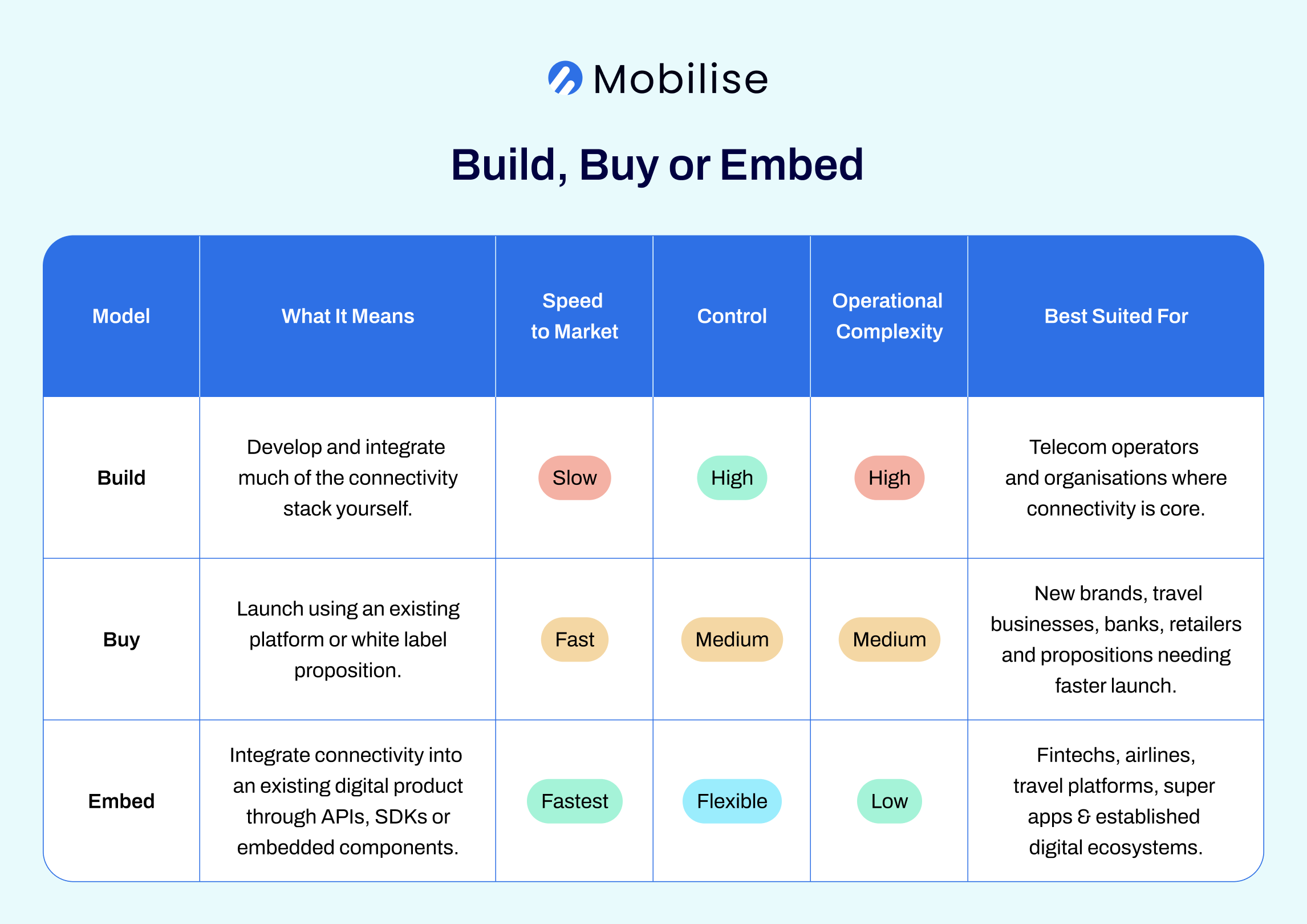
Quick Comparison
Option 1: Build
Building your own connectivity platform can provide significant flexibility and ownership.
It may allow an organisation to control more of the technology stack, integrations, customer experience and future roadmap.
That control, however, comes with responsibility.
A build-led strategy can require specialist telecom knowledge, integrations with multiple providers, operational tooling, billing and payment capabilities, customer lifecycle management, ongoing engineering investment and continuous platform maintenance.
For organisations where connectivity is the core business, that investment may be justified.
For businesses primarily trying to add connectivity to an existing proposition, it may introduce considerable complexity before customer demand has been proven.
Best Suited for:
- Established telecom operators
- Large digital businesses with dedicated engineering capabilities
- Organisations requiring extensive operational control
- Businesses where connectivity itself is a strategic core product
Option 2: Buy
Buying an existing platform or white-label proposition can significantly reduce the amount of infrastructure a business needs to create itself.
The technology, customer journeys and operational foundations already exist, allowing the organisation to focus more heavily on its proposition, brand, distribution and customers.
This can provide a much faster route to market while reducing implementation risk.
It is particularly useful when a business wants connectivity to become a visible part of its proposition but does not want to develop the underlying telecom stack from scratch.
Best Suited for:
- New digital connectivity brands
- Banks and fintechs
- Travel businesses
- Retailers
- Organisations testing a new market or proposition
- Businesses that want their own branded customer experience
Option 3: Embed Connectivity
The third option challenges the assumption that connectivity needs to become a separate product at all.
Instead, it can become a feature within the product customers already use.
An airline could introduce travel connectivity inside its existing app.
A fintech could allow customers to purchase and manage an eSIM alongside their other travel services.
A digital platform could use APIs to integrate connectivity into a wider membership, loyalty or customer proposition.
The customer does not necessarily need another app, account or separate relationship.
Connectivity simply becomes part of the journey.
This is one of the reasons embedded connectivity is strategically interesting: the experience can remain owned by the existing brand while much of the telecom complexity operates behind the scenes.
Best Suited for:
- Mobile banking and fintech applications
- Airline applications
- Travel platforms
- Super apps
- Membership and loyalty ecosystems
- Established digital platforms
Choosing the Right Connectivity Model
Build, buy or embed connectivity? Rather than asking which model is universally better, product teams should start with a few practical questions.
1. How Important Is Speed to Market?
If the priority is testing a proposition or launching within weeks or months rather than undertaking a large technology programme, buying or embedding an existing capability will often be more appropriate than building the complete stack.
2. Is Connectivity the Product or an Enabler?
This is perhaps the most important question.
For an MVNO, connectivity may be the core proposition.
For a bank, airline or travel platform, connectivity may be one component of a much larger customer experience.
If connectivity is primarily an enabler, embedding it into an existing journey may create more value than building a standalone telecom proposition.
3. How Much Operational Responsibility Do You Want?
More control generally means taking responsibility for more technology and operations.
Businesses need to decide how much of the telecom stack they genuinely need to own and where a specialist partner can remove unnecessary complexity.
4. Where Does the Customer Relationship Sit?
A separate connectivity brand may make sense when the organisation wants to build a dedicated proposition.
But if customers already regularly use an existing app or platform, introducing connectivity there may provide a more natural experience.
5. How Important Is Future Flexibility?
The initial decision does not need to define the business forever.
A company might begin with embedded connectivity, move into a white label proposition as demand grows and eventually develop a broader MVNO model.
The architecture should allow the commercial model to evolve.
Connectivity Is Becoming More Programmable
There is a wider industry shift behind this.
Telecom capabilities are increasingly being exposed through standardised APIs so developers and enterprises can consume network services without needing to understand or integrate directly with every layer of telecom infrastructure.
By March 2026, the GSMA reported that 86 operator groups, representing more than 300 networks and around 80% of global mobile connections, were aligned around the GSMA Open Gateway common API framework.
This does not mean every connectivity proposition will become an API-only service. It does, however, demonstrate the wider direction of the industry: telecom capabilities are becoming increasingly programmable, accessible and easier to incorporate into digital products.
For customers, the effect should be much simpler.
They do not necessarily want another app.
They do not want additional accounts unless there is a reason for them.
And they certainly do not want to understand the underlying telecom infrastructure.
They simply expect connectivity to work when and where they need it.
That is why the product opportunity is bigger than selling SIMs or eSIMs.
It is about removing connectivity friction from the customer experience.
How Mobilise Supports Different Connectivity Models
At Mobilise, we see organisations approaching the same connectivity opportunity from very different starting points.
Some want to establish a complete digital MVNO proposition.
Others want a branded, ready-to-market customer experience.
Others already have successful digital channels and want connectivity to appear inside those channels rather than creating something separate.
The approach therefore needs to follow the business model rather than force every organisation onto the same technology path.
Full Digital Connectivity Proposition
For businesses looking for a more complete MVNO model, the HERO® MVNO Platform provides the foundation for managing the wider digital connectivity proposition and customer lifecycle.
White Label Launch
For organisations prioritising speed to market and a branded customer experience, propositions such as the HERO® White Label eSIM App, HERO® V-eSIM App and HERO® Travel Suite provide routes to launch without building the complete technology stack internally.
Embedded Connectivity
For businesses that already have their own digital ecosystem, the HERO® API Suite, Mobile eSIM SDK and Mini Apps allow connectivity capabilities and customer journeys to be integrated into existing applications and platforms.
Scaling the Proposition
As the business evolves, capabilities including HERO® Orchestration, CRM, payments, analytics and lifecycle management can support greater operational sophistication, more providers, more propositions and a broader customer base.
The important point is not that every organisation needs every component.
It is that the connectivity model should be able to evolve as the business evolves.
Technology should adapt to the business — not the other way around.
Final Thoughts
For years, the conversation centred on whether a business should become an MVNO.
I think that question is becoming too narrow.
The more useful question for product leaders today is:
How should connectivity support our wider digital strategy?
For some organisations, the answer will absolutely be to build a dedicated MVNO proposition.
For others, a white label model may provide the right balance of brand ownership, speed and control.
And for a growing number of digital businesses, connectivity may work best when customers barely perceive it as a separate service at all — because it is embedded naturally into something they already use.
That is the bigger shift.
Connectivity is moving from being only a telecom service towards becoming a digital product layer.
The businesses that understand where that layer creates genuine customer value — and choose their model accordingly — will be much better positioned than those that begin simply by asking what telecom platform they should buy.
Frequently Asked Questions
Do I Need to Become an MVNO to Offer Mobile Connectivity?
No. Businesses can offer connectivity through white label platforms, APIs, SDKs and embedded experiences without necessarily operating as a traditional MVNO.
The appropriate model depends on the level of control, ownership and operational responsibility required.
What Are the Alternatives to Becoming an MVNO?
Common alternatives include launching a white-label connectivity proposition or integrating connectivity into an existing application through APIs, SDKs or embedded components.
What Is the Difference Between an MVNO and Embedded Connectivity?
An MVNO typically operates a dedicated mobile service proposition and owns a larger part of the customer and operational lifecycle.
Embedded connectivity allows telecom capabilities to become part of another product or digital journey, without requiring connectivity to become the organisation’s primary business.
What Is a White Label Connectivity Platform?
A white label connectivity platform provides an existing technology and operational foundation that another business can launch under its own brand.
This can reduce development time while still allowing the organisation to own the proposition and customer-facing experience.
Should a Bank or Fintech Become an MVNO?
It depends on its strategy. If mobile connectivity is intended to become a major stand-alone business line, an MVNO model may be appropriate.
If the objective is primarily to improve an existing travel, banking, loyalty or customer proposition, a white-label or embedded model may provide a simpler route.
Can a Business Start With Embedded Connectivity and Become an MVNO Later?
Yes. A business can begin with a more lightweight model to test demand before expanding into a wider connectivity proposition.
This is why flexibility in the underlying platform and architecture is important.
Build, Buy or Embed Connectivity – What Is the Difference?
Buying typically means adopting a more complete platform or launching a branded connectivity proposition.
Embedding means integrating connectivity capabilities directly into an existing app, website or platform through APIs, SDKs or other embedded components.
Which Industries Can Benefit From Embedded Connectivity?
Potential use cases exist across financial services, travel, aviation, retail, digital marketplaces, loyalty programmes, super apps and enterprise platforms.
The strongest use cases are generally those where connectivity solves an existing customer problem or complements a journey the business already owns.